
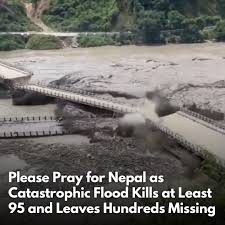
Khatmandu : As Nepali newspapers report the loss of several lives in a devastating flash flood in the Bhote Koshi River in Nepal's Rasuwa district, the scale of the tragedy continues to evoke widespread grief and anxiety across the Himalayan nation.
Reflecting on the profound impact of the catastrophe, a local shared, "The flood has affected areas bordering China, till Chitwan. The govt is conducting relief work; many bodies have been found. Nepal has suffered badly. I have heard that 200 tourists are also missing. It was a really painful incident. We are hopeful that our neighbouring countries will help Nepal."
While the upper Himalayan valleys grapple with the devastating aftermath of the sudden inundation, life in the capital remains relatively undisturbed by direct flooding, though shadowed by the immense national tragedy.
Sharing perspective on the situation in the capital, another local in Kathmandu said, "I have read about it in the newspaper. The water is not expected to reach Kathmandu. The situation is normal in Kathmandu city. Relief should be sent to the affected area."
Providing official context to the unfolding disaster, Nepal was struck by massive flash floods following a powerful surge along the Bhote Koshi River, resulting in widespread displacement and extensive damage to homes, roads, bridges, hydropower facilities, and other critical infrastructure.
This prompted security and disaster-management agencies, local authorities, and health services to fully mobilise for search and rescue, evacuation, emergency medical assistance, and relief operations as authorities closely monitor river systems and downstream flood risks.
Providing further details, Nepal Embassy sources stated, "So far, 175 bodies have been recovered, while many people, both locals and tourists, are still missing. According to the latest available information, 476 people from 28 countries have been reported missing. These figures remain subject to verification as search and rescue operations continue."
Outlining the current administrative focus, the briefing from Nepal Embassy sources added, "At this stage, our immediate priority is to save lives and support search and rescue, evacuation and relief efforts in the affected areas.
In view of the extensive damage caused by the floods, the Government will continue to assess the situation and emerging needs on the ground and, where necessary, communicate specific requirements for assistance through established official channels."
Elaborating on the scale of the emergency, the disaster was triggered when a massive debris-laden flood occurred in the Lhende Khola following a glacier or ice rock collapse approximately 20 kilometres northeast of the Rasuwagadhi border point.
Surging from the Tibet side into the Bhote Koshi River, the torrent tore through Rasuwagadhi, Timure, and Syaphru Besi before entering the Trishuli River, severely impacting coastal regions across Rasuwa, Nuwakot, Dhading, Gorkha, and Chitwan districts.
The catastrophe has critically damaged 35 motorable bridges, 45 suspension bridges, and 40 kilometres of paved roads, while collection of comprehensive loss data remains ongoing.
In response, the Office of the Prime Minister of Nepal stated that search, rescue, and relief operations have been aggressively scaled up using military and private sector helicopters alongside ground troops from the Nepal Army, Nepal Police, and APF, who operated through the night to reach stranded individuals in Timure and Syaphrubesi.
Medical teams spanning district hospitals to premier institutions in Kathmandu have been deployed to treat the injured, while temporary shelters, food, clean water, and medicines have been arranged at Nepal Army barracks.