

Itanagar : Usha Vedasalam completed the Kailash Mansarovar Yatra just a week before the devastating floods in Nepal. This is her account of the pilgrimage.
Though I had planned and booked the journey for June 15, the Indian government had halted permissions and travel at the Tibetan border.
I waited until August 10 and was about to cancel my trip.
It was a 13-day trip for which I had paid Rs 3 lakh.
But on August 11 I got the permit, and on August 12 I took the 6.30 am flight from Chennai to Delhi. I work as a store manager in Auroville, Puducherry.
There were 40 of us from across Tamil Nadu. I am 48 and single while the rest of the travellers were mostly aged above 55.
I was told the maximum permissible age limit for the permit was 68.
On August 12 we reached Kathmandu around 4.30 pm.
The next day, we did some sightseeing and shopping to acclimatise ourselves. By then our Chinese visas had arrived, which are valid for three months.
On day 3 we reached the border, where the immigration formalities were completed.
Two of our co-travellers had Covid, so they were made to sit separately while the officials checked our baggage and documents and stamped them for clearance.
Usha travelled to Kailash Mansarovar with 39 other travelers from Tamil Nadu
The photograph was taken after completing the immigration formalities at the Nepal-China border. A week later, on August 26, 2026, the area was washed away by the flash floods.
On day 4, we reached the border town of Kerung in China. From Kerung, we travelled to Saga in a four-wheeler.
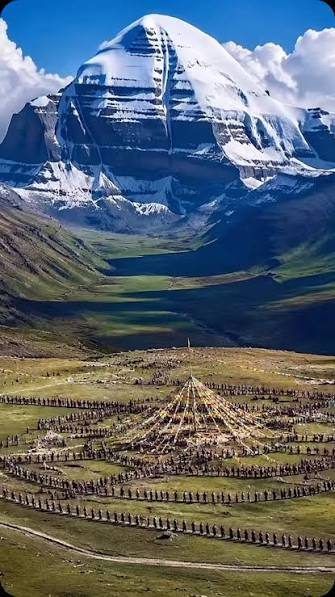
From Saga, we travelled directly to Lake Mansarovar. After that, we began the Kailash parikrama, which involves going around the sacred Mount Kailash.
The mountain is considered divine, and the parikrama is similar to the girivalam (pilgrimage) we undertake around Thiruvannamalai, Tamil Nadu.
Kailash is Lord Shiva's home. Since we cannot go inside, we walk or travel on horseback around the mountain to complete the parikrama.
I have always wanted to do it because it is considered sacred to seek the divine's blessings, and it is a pilgrimage of a lifetime.
The older you grow, the more difficult it becomes to undertake this journey.
Usha at Gouri Kund near Dolma Pass
The Kailash Mansarovar parikrama is approximately 42 km long and takes three days to complete.
The journey can be extremely challenging because of the difficult terrain. There are steep stretches and long downhill walks, which can be exhausting.
Through the trip, we cover four different phases -- North, East, West and South.
On day 1 of the parikrama we covered 14 kilometres by foot. We were provided with oxygen cylinders.
Those whose oxygen levels fell below 70 were advised not to continue the journey.
Ten members fell sick and had to be hospitalised.
We started early. The best part of the North phase is the time between 8 am and 8.10 am when the Sun comes up and you get to see a golden Kailash.
As the Sun's glow falls on Mount Kailash, the sight is breathtaking.
It lasts only for about 10 minutes. If you miss it, you won't see it again.
On day 2 of the parikrama, we went further up towards Dolma Pass, which is approximately 18,500 feet above sea level.
This leg is 22 km, during which we pass through Gauri Kund, where Goddess Parvati is believed to have bathed.
It is a very steep trek, and you can't take 10 steps together at once. Some of us had fever and cold, so again, 10 members had to quit their journey.
Besides, it was raining, so the road was muddy and slippery as well.
The third day was relatively easy because it was only six km.
But I could not finish one stretch of about six kilometres because I was not feeling well. The cold and rain made things even more difficult, and my health became a concern. So, I hired a vehicle to complete the journey.
From there, we completed the Chinese immigration formalities and travelled back to Kathmandu.
For the journey, you need a valid Indian passport, a Tibet travel permit and a Chinese visa to enter. Fortunately, we received our visas in about one-and-a-half days.
Riding on a horseback during Kailash yatra
Before starting the journey, you need to be physically and mentally prepared for the trip. We were told to practise walking at least 5 to 10 km every day and do breathing exercises. Those who do yoga regularly benefited.
The temperature can drop to -20 degrees, and there are no clean toilets. As you go higher, there is only one pot that everyone has to use to answer nature's call.
As we took Diamox to battle altitude sickness, it made us urinate frequently. There was no other choice but to use whatever toilet was available. It was very unhygienic.
Some of us had diarrhoea and vomiting, so the stench was unbearable. Throughout the three days, we didn't brush our teeth or take a bath because there was no water or wash basin. We survived on oats kanji, dal-rice, fruits and dry fruits.
The food is mostly liquid-based, and they bring it on yaks.
The Mansarovar Yatra does not only test your physical endurance. It tests your mental strength, willpower and resilience, too.
Nepal Mansarovar yatra by Usha Vedasalam
The yatra is not meant for everyone. If you are someone who is fussy, sick or do not have an adaptable personality, you will find it extremely difficult to survive in those conditions.
Out of 40 members, only 10 could successfully complete the parikrama. The rest fell sick and had to be hospitalised.
On our way back to Kathmandu, we heard about a landslide. Our return journey was delayed by a few hours.
Once we reached our hotel rooms in Kathmandu, the first thing we did was take a bath.
We returned to Chennai from Kathmandu on August 24.
Two days later, when we heard about the floods, I could only thank God that all of us had reached home safely before the tragedy struck.
Some of the places where we clicked pictures have been washed away by the floods. It is so devastating to watch.
While I am grateful, I am praying for the families of the missing travellers.
Despite all the challenges, the Kailash Mansarovar Yatra was a lifechanging, spiritual experience for me.