

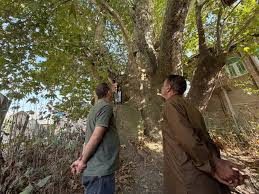
SRINAGAR: Notwithstanding over six centuries of changing seasons and generations, Asia’s oldest Chinar tree—which is nearly 650 years old in the Chattergam area of Jammu and Kashmir’s Budgam district—still stands tall and green.
Though some of its older and dried branches have fallen off, the remaining portion is still green.
This was stated by the government in the Assembly last week. The authorities have initiated protection and preservation measures to conserve the heritage tree. Iron fencing has been installed around the critical root zone of the tree to prevent the soil compaction and root suffocation.
Syed Barkat Hussain, a resident of Chattergam, Budgam, said, “It is the duty of the government as well as locals to preserve such heritage,” he said.
Residents have called for proper maintenance of the site and demanded that it be developed and promoted as a heritage tourism destination.
Locally known as “Boueen”, Chinar is a distinctive feature of Kashmir’s landscape and is found in almost every part of the Valley. The tree is believed to have been introduced in Kashmir from Persia and can grow up to 30 metres in height and have a girth of 10 to 15 metres at ground level. It takes around 150 years for a Chinar to reach its full size.
According to a survey-based census by the J&K Forest Research Institute (JKFRI), around 30,000 Chinar trees have been surveyed across Kashmir, excluding those located inside security force camps and installations. As part of efforts to strengthen protection of Chinar trees, the government began geo-tagging Chinar trees in 2025 and assigning QR codes to them for monitoring. A QR-based digital plate has been affixed to each Chinar.
As part of efforts to strengthen protection of Chinar trees, the government began geo-tagging Chinar trees in 2025 and assigning QR codes to them for monitoring.
A QR-based digital plate has been affixed to each identified Chinar using a specialised spring-enabled metal mechanism.