
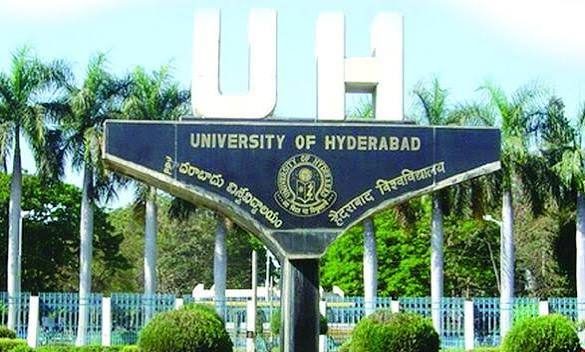
Hyderabad: A hearing-impaired researcher has complained that the University of Hyderabad (UoH) earmarked no disability-quota seat for its PhD in Communication, prompting the Chief Commissioner for Persons with Disabilities (CCPD) to seek the university’s reservation and selection records.
The University Grants Commission (UGC) has separately asked UoH for a factual report and details of action taken or proposed.
The Chief Commissioner for Persons with Disabilities (CCPD) has now asked the university to open its books on how it reserves and selects, while the University Grants Commission (UGC) has demanded a factual report and details of action taken or proposed.
M Vikram Aditya Reddy, who has 83 per cent hearing impairment, complained to the CCPD against the UoH registrar.
His father told the authority that Vikram holds a Master of Fine Arts (MFA) with first class and distinction, and has qualified the National Eligibility Test (NET) with JRF in Mass Communication and Journalism. Vikram applied after declaring his disability and submitting the required documents.
In its order dated Monday, September 21, the CCPD, a statutory disability-rights authority, gave UoH 15 days to file a point-wise reply with supporting documents. It has not yet recorded a final finding of violation.
The CCPD said an eligible candidate cannot be deferred merely for administrative convenience. It pointed to Section 32 of the Rights of Persons with Disabilities (RPwD) Act, which requires government higher-education institutions to reserve at least 5 per cent of seats for persons with benchmark disabilities (PwBD). Candidates in this category who qualify on merit must be counted against open seats, it said.
UoH’s controller of examinations said an approved roster provides 5 per cent reservation across the overall intake, monitored by liaison officers, the Reservation Cell and other officials.
The university said admissions for 2026-27 were still under way and that PwBD candidates were being considered under applicable norms. It added that the Communication cycle had already closed and another would follow.
On exams, UoH first claimed that scribes and compensatory time were being provided. It later admitted that its statement on compensatory time was wrong and confirmed the entitlement of 20 minutes for every hour of examination.
After allegations that hearing-impaired candidates were not given suitable alternative or objective-type questions, the CCPD recommended proper implementation of the accommodation guidelines.
Records the university must produce : The CCPD has sought the reservation roster, university-wide and department-wise seat matrices, the seats allocated to Communication, the prospectus, and data on PwBD applications and admissions.
It also wants the merit-quota accounting, the policy for allocating seats in departments with fewer than 10 seats, the disability-support mechanisms, and the examination guidelines and question papers.
For Vikram’s case, it has asked for details of his eligibility, shortlisting, marks and the selection criteria, along with the reasons he was not called for an interview, if that was the case.
The UGC’s letter separately raised concerns over unfilled vacancies and alleged inconsistencies in official records. Referring to a representation from Vikram’s father on Monday, August 3, it asked UoH to examine compliance with the Act and UGC guidelines and to report within 15 days of receiving the letter, with a copy to the commission.