
Chennai : Tamil Nadu CM Joseph Vijay made an unprecedented move in the state Assembly, breaking a long-standing seating tradition by joining his ministers in the front row, sparking discussions on legislative protocols and official presence.
Tamil Nadu CM C Joseph Vijay broke a long-standing assembly tradition by sitting with ministers in the front row.
Chief Ministers typically occupy a separate, spacious chair close to the Speaker's Chair, distinct from ministers.
This is believed to be the first time a Chief Minister has shifted from their official chair to sit with colleagues.
A separate discussion arose regarding the necessity of department secretaries' presence during Assembly sessions.
The Speaker concurred with the Leader of the Opposition, stating senior officials would be asked to be present in the House.
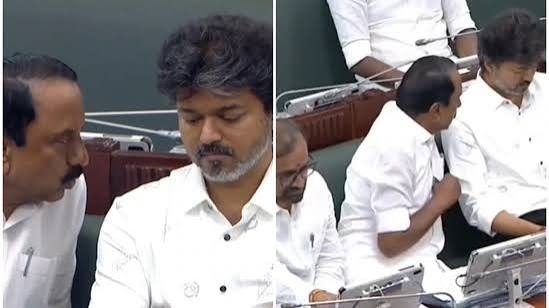
Tamil Nadu Chief Minister C Joseph Vijay on Thursday made heads turn in the state assembly when he casually moved from his chair in the House and sat besides ministers in the front row, marking a major departure from a long-standing tradition vis-a-vis seating.
Normally, the chief minister occupies a separate and spacious chair close to the Speaker's Chair and the ministers are seated separately, next to him/her, as per their seniority, in the front row.
The facing row is occupied by the Leader of the Opposition and leaders of the Legislature parties based on their numerical strength in the 234-member House with their respective party members behind.
CM Vijay's Unprecedented Seating Arrangement : In the afternoon session, Vijay casually moved from his chair, located on the right side of Speaker J C D Prabhakar and sat between Ministers K A Sengottaiyan (also Leader of the House) and Aadhav Arjuna.
According to a source, in the past no chief minister sat on the seat meant for ministers.
Normally, the ministers or legislators change their positions for a brief while to speak with their colleagues. But this perhaps is the first time a chief minister has shifted from his official chair to have a word with his colleagues.
Debate On Department Secretaries' Presence : Earlier in the day, Leader of the Opposition Udhayanidhi Stalin pointed out that the department secretaries should be asked to be present in the House when important issues are raised in the House by the members.
"The Speaker mentioned that then chief minister spoke about the Karur (stampede) incident during the previous DMK regime. Then our leader and CM (M K Stalin) was present in the House and so were the chief secretary and department secretaries. Now, both the chief minister and department secretaries are not present in the House," Udhayanidhi said.
Responding, Aadhav Arjuna said the secretaries were present in the adjoining "war room" and taking notes from the members' speeches.
The Speaker concurred with Udhayanidhi and said the senior officials will be asked to be present in the House during assembly sessions.
The CM had attended certain government events earlier in the day, and had turned up for the session later.
...............
Andhra CM N Chandrababu Naidu directs health officials to rollout Sanjeevani project from Jan 1
Chief Minister N Chandrababu Naidu highlighted early success from pilot implementation of the project in Kuppam constituency and Chittoor district.
CM Chandrababu Naidu holds a review meeting on the Sanjeevani Project.
CM Chandrababu Naidu holds a review meeting on the Sanjeevani Project.Photo | Express
S Guru Srikanth
Updated on:
27 Aug 2026, 9:10 am
2 min read
Add as a preferred source on Google
VIJAYAWADA: Chief Minister N Chandrababu Naidu on Wednesday directed health officials to roll out the ambitious Sanjeevani Project across Andhra Pradesh starting January 1, 2027, aiming to transform healthcare delivery through artificial intelligence (AI) and universal digital health records.
Reviewing the project at his camp office alongside Health Minister Y Satya Kumar Yadav, Health Secretary G Veerapandian, and representatives from implementation partner Tata MD, the Chief Minister emphasised that introducing predictive, preventive, curative, and cost-effective medical services will drastically reduce out-of-pocket medical expenses for families across the State.
Naidu highlighted early success from pilot implementation of the project in Kuppam constituency and Chittoor district. According to clinical data presented by the Health Department, the pilot project yielded significant health outcomes in Chittoor, bringing 56% of monitored hypertension cases under control, and reducing diabetes severity by 16%.
Furthermore, the project drove a notable surge in primary healthcare utilisation, with a feedback survey revealing that 91% of participating citizens reported heightened health awareness following AI-assisted screening, treatment, and follow-up care.
To ensure seamless expansion across all 28 districts, health officials presented a detailed 90-day execution roadmap to Naidu. The structured rollout plan encompasses baseline field studies, establishing digital infrastructure, conducting training for medical staff, and seamlessly integrating data with both national and State healthcare portals.
As an official partner, Tata MD has been tasked with driving continuous technological innovations to support the AI-backed healthcare ecosystem.
Stressing the importance of patient privacy, Naidu instructed officials to enforce strict data security protocols while establishing a real-time monitoring dashboard.
He called for the widespread integration of ‘AI Doctors’ to assist in diagnostics, alongside traditional systems like Homoeopathy, Ayurveda, Yoga, and Pranayama.
He ordered strict oversight of hospital administration, directing the department to institute a policy to terminate underperforming outsourcing agency providers in sanitation and facility management.
................
Tech, AI must help make justice more accessible: CJI Surya Kant
NEW DELHI: The Chief Justice of India (CJI) Surya Kant on Thursday highlighted the growing economic relationship between India and Germany, stressing the need for trust in international commerce and robust arbitration mechanism.
Speaking at the Indo-German arbitration conclave in Berlin, Germany, CJI Kant said disputes are a natural feature of commercial activity, but their existence does not indicate a failure of trust.
“What matters is whether the legal system provides a reliable mechanism through which disagreements can be resolved without undermining the commercial relationship itself,” he said.
CJI Kant added that an arbitration agreement is more than a procedural clause in a contract, and it represents a commitment to a method of resolving future disagreements.
He also said that the judiciary’s governing principle is that artificial intelligence may augment judicial reasoning, but it cannot substitute judicial conscience, and that a permanent apex body has been proposed to supervise the accountability of the new technology.
Speaking at the bilateral meeting with Ulrich Herrmann, the presiding judge of the Federal Court of Justice at Karlsruhe in Germany, CJI Kant said that artificial intelligence (AI) is being used in certain defined support functions. He also outlined India’s ongoing digital transformation through Phase III of the eCourts Mission Mode Project.
‘AI used in support functions’
Speaking at the bilateral meeting with Ulrich Herrmann, the presiding judge of the Federal Court of Justice at Karlsruhe in Germany, CJI Kant said that AI is being for support functions like legal research, judgement translation into 16 languages and as a conversational interface for citizens to look for case status and procedures.