
New Delhi: The Delhi University has more than 7 lakh students across its regular, professional and open-learning programmes, while reports put the varsity’s hostel capacity at only around 7,000 to 8,000 rooms.
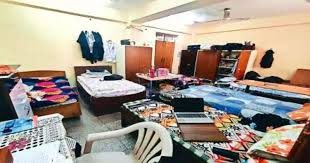
The shortage has left many students, especially those coming from outside the national capital, dependent on private paying guest (PG) accommodation in areas such as Satya Niketan.
The issue came up in the Delhi High Court on Monday (September 7), a day after a five-storey building known as ‘Hostel Days’ collapsed, killing seven people. The building housed a boys’ PG and came down during repair work on Sunday (September 6).
The court directed the Municipal Corporation of Delhi (MCD) to inspect all PG accommodations and hostels within its jurisdiction within a week.
The inspection will check whether these premises have the required permissions and follow building bye-laws. The civic body has also been asked to find out how many students are living in each private hostel.
DU’s hostel shortage : The university does not publish a single number for its total hostel rooms. Reports put its capacity at around 7,000 to 8,000 rooms. Based on these numbers, roughly one in every 31 students can get a hostel room.
A 2025 report said more than 30,000 undergraduate students had applied for hostel accommodation, while fewer than 10 per cent managed to secure a seat.
The High Court has asked the DU to provide details of the number of students enrolled from outside the city and the hostel facilities available for them. The court also sought information on whether there is a regulatory system governing private hostels.
Delhi University Vice-Chancellor Yogesh Singh has asked college principals to review residential facilities for students and speed up ongoing hostel projects after the Satya Niketan collapse.
Court orders safety check of private hostels : The High Court has directed the authorities to examine the Satya Niketan building collapse in detail.
The inquiry will look at whether the building had all the required permissions, identify officials responsible for any lapse and state what action has been taken or proposed against those found responsible.
The MCD's inspection of private hostels will also check whether they are being operated with the required approvals and under the applicable building rules. The civic body has been asked to submit details of the number of students staying in each such premises.
During the hearing, the court also addressed unauthorised construction by some operators. It observed that buildings approved for two floors are sometimes extended to several more floors while the original foundation is left unchanged, creating safety risks.
The court was hearing a public interest litigation (PIL) filed after the building collapse. The authorities have been asked to submit separate replies within 10 days. The matter will be heard again on September 25.
The collapsed building was constructed on around 55 square yards in a resettlement colony. According to MCD officials, permission had originally been given for a Ground+1 structure, while the collapsed building was a Ground+4 structure. No building plan had been approved.
The building was decades old and was being used as a boys' PG. Repair work was underway when it collapsed.
Delhi Chief Minister Rekha Gupta visited Satya Niketan during the second and final day of the search and rescue operation. She said water had accumulated in the basement and this led to the collapse. The tragedy killed seven people.
Hariram Bansal, the owner of the building, was arrested along with his wife and their son in Bhiwadi, Rajasthan, after a multi-state search involving 10 police teams.
Five MCD officials suspended : The MCD suspended five officials with immediate effect on Monday, a day after the collapse.
Those suspended are Deputy Commissioner (South Zone) Rakesh Kumar, Superintending Engineer Ranvir Singh, Executive Engineer (Building) Lalit Kumar Goel, Assistant Engineer (Building) Sunil Chauhan and South Zone Junior Engineer (Building) Ashish Kumar.
Residents in the area have also complained about persistent waterlogging, unchecked construction and "apathy" by building owners and civic agencies.