
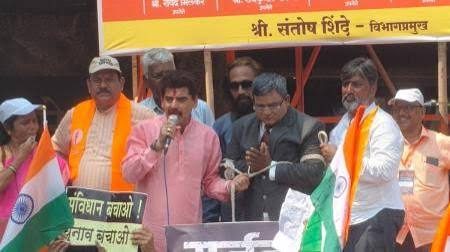
Mumbai : Amid sweltering October heat in Mumbai, Uddhav Thackeray turns up the heat against Chief Election Commissioner Gyanesh Kumar, hinting obliquely about Nuremberg-like trials once the wheels of electoral fortune change.
When Uddhav Thackeray invoked Adolf Hitler and the Nuremberg trials towards the end of Sunday's Garjana Protest March in Mumbai, it was not just another political swipe at Narendra Modi, Amit Shah or Chief Election Commissioner Gyanesh Kumar. What he said immediately afterwards made one sit up.
Hitler, Uddhav said, had kept the entire machinery of the State under his control. But after he was gone, the Nuremberg trials followed, and those who had worked with him were hunted down and punished one by one.
Uddhav Thackeray invoked the Nuremberg trials in his remarks, then said the people of India will punish CEC Gyanesh Kumar if he acts arbitrarily, suggesting accountability once the BJP's hold on power ends.
The Garjana Morcha demanded Gyanesh Kumar's resignation over alleged electoral roll manipulation and mass voter deletions, including about two crore voters in Maharashtra.
Raj Thackeray, in a notably subdued speech, called the nationwide SIR illegal, demanded it be scrapped in Maharashtra and urged an end to voting machines.
The CEC, Uddhav said, may believe nothing can happen to him once he retires, and that a law passed by Parliament protects him. But there was no such immunity under the law.
If he acted arbitrarily, "the people of this country will punish Gyanesh Kumar". As for Kumar's "puppeteer", those sitting above him, "whether there are two of them, three or five", would also be dragged onto the roads and punished, notably "within the framework of the law".
One could dismiss this as rhetoric, since politicians' speeches are full of such warnings. But the sequence is hard to ignore. First Hitler, then Nuremberg, then the punishment of his accomplices and immediately after, Gyanesh Kumar and those Uddhav described as the people above him.
That, more than anything else said at the rally, explains why the Nuremberg reference will linger long after the crowds have gone home.
This Was Not the Uddhav or Raj We Usually Hear
The Thackeray cousins -- Uddhav and Raj -- flanked by the latter's son Amit, Rajya Sabha MP Sanjay Raut and Nationalist Congress Party (Sharad Pawar) leader Jayant Patil.
The speeches of the two Thackeray cousins were unlike the ones they are known for.
Raj, particularly, was almost devoid of his trademark aggression and satire audiences expect from him. He sounded less like the Raj who demolishes opponents with sarcasm and more like someone making a serious argument about what he believes has gone wrong with India's electoral system.
"I'm not angry that you sit in power," he told the gathering, pointing to those he believes cheated the electoral process. "I'm angry about how power is obtained and by what means."
That is perhaps the simplest way to understand his speech. He was not saying the BJP should not be in power. He was questioning the manner in which, according to him, that power had been acquired.
Voters, Raj argued, should decide who comes to power, who stays in Opposition and who loses. A ruling party must always fear that one wrong decision could send it out of office. That fear, he said, has disappeared both in Maharashtra and at the Centre.
Then he asked a question that deserves more attention than the sloganeering around the Special Intensive Revision (SIR). What happens if the party in Opposition today comes to power tomorrow and uses exactly the same methods against those ruling today?
Power, after all, is not permanent. The BJP knows this, as do the Congress, the Shiv Sena and the Nationalist Congress Party. At least theoretically, they should.
The Question Both Thackerays Keep Asking
Raj said since 2017-2018 he has been warning about what he calls vote chori (theft). He recalled meeting Opposition leaders, including Sonia Gandhi and Mamata Banerjee, and telling them that parties needed to act.
His Sunday argument rested on one question: How can the number of voters change so dramatically in such a short time? He contrasted the 2024 Lok Sabha election, in which the BJP and Eknath Shinde's Shiv Sena fared poorly, with the assembly election a few months later swept the Maha Vikas Aghadi aside and gave the BJP, the Shinde Sena and Ajit Pawar's NCP an unprecedented majority in the Maharashtra Vidhan Sabha.
He asked how tens of lakhs of voters could have been added within six months (the duration between the Lok Sabha and Vidha Sabha elections).
Uddhav attacked the election commissioner's appointment. He asked why the post is not filled by election, like the President's, and alleged that the appointment process had been tilted towards the government.
He argued that the Election Commission was assuming powers that did not belong to it. He called Gyanesh Kumar an "instrument" of the BJP and said election officers and BLOs would do the actual work while the CEC took the credit. "Does this country belong to Gyanesh Kumar's father?" he asked.
Uddhav's speech, unlike Raj's, grew sharper as it went on. He reminded the audience of Modi's "Make in India" slogan, then delivered the jab. If India was going to "manufacture a dictator" under that banner, he said, the people had already buried that dictatorship.
He spoke of captured institutions, fear among voters and the alleged deletion of names from the rolls. He also took on the government's explanation that SIR was needed to weed out illegal Bangladeshis. His response was blunt: If the Centre controls the border, how did Bangladeshis enter Maharashtra in the first place?
Then came Hitler. Why that example? It could be read as a simple reminder that those who wield enormous power cannot assume it will protect them forever. But the timing makes that explanation only partly convincing, because the very next subject was Gyanesh Kumar.
Is Uddhav Warning Gyanesh Kumar?
This is where the speech becomes politically interesting. Uddhav did not say, in so many words, that a future government would hold a Nuremberg trial of the current chief election commissioner. Nor did he call for punishment outside the law. He specifically said Gyanesh Kumar and those above him would be punished "within the framework of the law".
But he rejected the idea that retirement could insulate Gyanesh Kumar from future scrutiny. "What kind of law is this?" he asked, arguing that even the prime minister or President enjoys no such immunity.
One wonders whether this was Uddhav's way of telling Gyanesh Kumar, and by extension the establishment he believes protects him, that power can change hands and that today's actions can become tomorrow's cases.
Gen Z was notable by its absence. A group of young Mumbaikars described the protest as a conventional political gathering and said their generation had largely stayed away. They insisted, though, that they were not indifferent to the SIR issue and would keep protesting until Gyanesh Kumar resigned.
Neha Kadam, who identified herself as a Gen Z participant from Mumbai, had a direct message for Modi: If Gyanesh Kumar does not resign, the prime minister could be next to face the people's anger.
For now, Uddhav has issued his warning. He told the crowd that Sunday's march was the first and "not the last".
So was Uddhav saying Gyanesh Kumar would face a Nuremberg-like trial after the BJP loses power? Not literally. But was he warning that those he believes are manipulating India's electoral system should not assume today's protection will last forever? That, clearly, was the message.
Perhaps that is why the word "Nuremberg" will prove more politically consequential than the thousands of slogans raised on Sunday.
Uddhav ended by asking whether the people's heads had "heated up" amid the hot weather, against what he called the atrocity of the dictator and if their anger would spill onto the streets in the days ahead.
The political heat in Maharashtra, it appears, is only beginning to rise.