
Gaza : For Gazans, who have lived through the horrors of the last three years, life means a continuing encounter with impermanence and the repeated discovery that a home, a friendship, a livelihood, a familiar life and even one's former self can become things that exist only in memory.
Many in Gaza today treat grief as a test of what remains within human control when the world takes away what cannot be restored. For Gazans, who have lived through the horrors of the last three years, life means a continuing encounter with impermanence and the repeated discovery that a home, a friendship, a livelihood, a familiar life and even one's former self can become things that exist only in memory.
Omar Aldalou was at home in Gaza City, preparing to have breakfast before going to work, when the rockets began pounding the besieged Palestinian enclave. People in his house woke up confused, asking the same question -- what was happening? There were rockets being launched, explosions, shouting and people chanting, but in those first moments he says nobody around him understood the scale of what had begun or what would come next.
Donate For Health
"The first thing that comes to mind is confusion. My emotions were completely mixed, and in those first moments, none of us really understood what was happening. There were rockets being launched, sounds everywhere, and voices of people chanting and shouting. Everything felt unreal," Omar, 31, told NDTV.
Omar, who once worked as a software engineer at a Gulf-based company, did not leave the house because there was nowhere to go and no clear understanding of what was happening, but the uncertainty did not last long.
"Within only a few hours, everything turned upside down. The bombardment became extremely intense, and the neighbourhood where I lived was among the first areas to be heavily hit," he told NDTV.
A house nearby was struck, and the danger that had initially seemed distant was suddenly close to his family. A Hamas member who had taken part in the October 7 attack on Israel was from his area, and his family home and his house were targeted. Omar's home was very close by, making the threat immediate. Electricity and internet access soon disappeared, cutting the family off from much of the outside world at precisely the moment when they were desperate for information.
"The truth is that we had no idea what was happening or what was coming next. We had no preparation and no time to understand the scale of what had begun. Even by the end of that first day, everyone around me was still in shock. We did not know what to do, where to go, or what the next step should be," Omar said.
The 31-year-old spent the first two nights in his home, but as the bombardment intensified, remaining there became increasingly dangerous. Leaflets were dropped ordering people in the area to evacuate, and he was forced to make the decision he had hoped would be temporary -- leave his house. Before walking away, he took photographs of his home and his room.
He was crying as he did it because displacement was not an unfamiliar experience for him; he had already experienced being displaced in 2014 following Israel's offensive and understood the pain of leaving a place without knowing what would happen to it or when he might return.
"You stand inside your home and suddenly have to decide what to take and what to leave behind. But everything has value. Every object has a story," Omar told. "I took only a few summer clothes because I thought perhaps we would leave for one or two days and then come back. I left my laptop, my personal belongings, my books and almost everything else behind. I had no idea that what I thought would be a short displacement would turn into years of loss and instability."
Asked what has been the most difficult thing he has lost over the past three years, Omar struggled to identify a single answer because, in his description, the defining experience of the war has been the accumulation of losses rather than one isolated tragedy.
"It is very difficult for me to choose one thing, because these three years have been a continuous process of losing things," he said. "There are 365 days in a year, and sometimes it feels as though every single day since October 7 has brought a new loss."
"But perhaps one of the hardest losses is the loss of stability itself. Before the war, I was a very energetic person. I loved working, learning, communicating with people, laughing and spending time with friends. Three years of war, pressure and fear have created a completely different person. Sometimes I feel as though a new person was born out of this war -- someone very different from the person I was before. War does not only take away your home or your job. Sometimes it takes parts of who you were," he added.
At first, Omar and his family had to find somewhere safer to stay. Then they had to find electricity, internet access, water and food. Eventually, even getting through one day became a challenge in itself. There were periods when they went two or three days with almost nothing to eat because there was very little food available and whatever could be found in markets was often far beyond what they could afford.
"War completely changes your priorities. You stop asking yourself what you will do next week or next month. Instead, your questions become: How will we get through today? Where will we find food? Where will we get drinking water? Where will we sleep tonight? That is how we survived day by day, and sometimes hour by hour," he told.
"People outside Gaza may also find it difficult to understand what years of this kind of pressure do to a human being. Your personality changes. Your face changes. Your view of life changes. Even your ability to feel joy or imagine a future changes. War is not only the sound of explosions. War is hunger. It is displacement. It is losing your home, your work, your friends and your sense of security, one piece at a time," he added.
The children around him, he said, have almost forgotten what it means to simply be children. Their concerns are no longer limited to toys, school, games or other ordinary childhood interests.
Instead, they have learned to worry about food. A child may spend the day thinking about how to reach a takiyya, a communal meal prepared from whatever limited and often poor-quality ingredients are available, simply so that they can eat something.
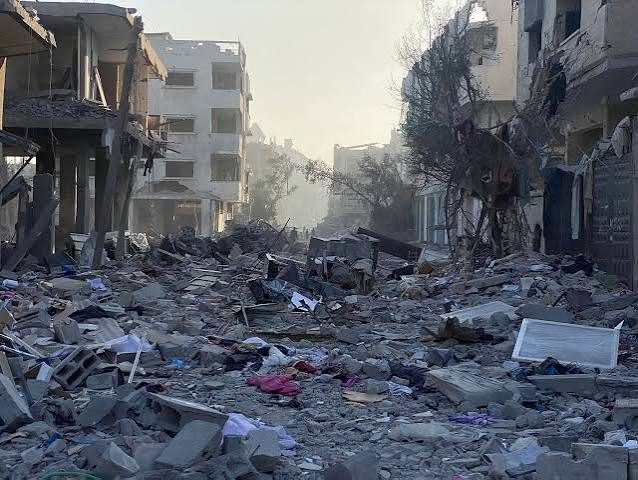
"These are responsibilities and worries that no child should ever have to carry," Omar told NDTV. "Even their faces and appearance have changed. You can see something heavier in them now. They carry worries far beyond their age. When I look around Gaza, I see destruction everywhere."
"Today, I speak first and foremost as an ordinary Palestinian civilian in Gaza who has lived through the consequences of this war," Omar told NDTV.
"After everything I have experienced, I do not see responsibility as belonging to only one side. In my view, Hamas bears responsibility and made decisions for which ordinary people in Gaza have paid an enormous price.
Israel also bears enormous responsibility for what has happened to civilians in Gaza and for the scale of destruction and suffering we have experienced. But my sense of disappointment goes far beyond Hamas and Israel. I feel deeply abandoned by the world."
'Thankfully I Don't Have Children'
Similarly, for Aseel Hamdan, 30, the earliest memory since the events of October 7, 2023 was the sound of glass breaking inside her home and a red light crossing the sky. It was around 8 pm when a neighbouring house was bombed without warning.
Aseel, who works as an English trainer and staff supervisor at a local language institute in Gaza City, remembers sitting on her bed and then, almost instantaneously, finding herself in the living room as the windows shattered around her.
"My back was cut by the broken glass," Aseel told NDTV. "I remember how we all immediately checked on one another, making sure everyone was okay and that no one had been hurt. Suddenly, we began hearing sounds that were somewhat like thunder” he added.
“When we looked up at the sky, we saw the sight of rockets streaking across it. Unfortunately, our residential neighbourhood had always taken the brunt of the violence in every war, so we were simply sitting there, waiting to see what would happen.”
After that silence, we knew that whatever response was coming would shake everything, and that this would not be like any previous war or escalation."
At first, Aseel and her brother lost their jobs. Then the family was forced to leave the home in which they had lived for more than two decades, leaving behind photographs, memories and the objects that had accumulated over a lifetime.
The losses did not stop there. Aseel says the family lost more than 25 members of their extended family, including her only uncle and his entire family. Later, both of the family's homes were lost. In between those losses came repeated displacement.
"We lived in places that didn't feel like ours and had to adapt to a life that was never meant to be ours. We were displaced more than five times. We didn't have the luxury of falling apart," she told.
The physical consequences of displacement and the changing conditions in which the family lived also began to affect their health. Hamdan says members of the family suffered from illnesses linked to changes in their environment and water.
"Personally, I contracted hepatitis twice, and at the time, there was no suitable medication available. Every single one of us changed, but the biggest change was that our sense of fear became much stronger. Even now, if one of us is late coming home, we keep checking on them and asking where they are and whether they're okay. I believe we developed trauma from losing so many people and things," Aseel told NDTV
"I lost my only uncle, his wife, and 17 members of his family-my family. It was one of the hardest things I have ever experienced, especially because we never had the chance to say goodbye to them, either before or after the burial, because it was not safe," she added.
She lost her home, her room and everything that belonged to her. She had kept childhood toys there, along with some of the clothes she had worn as a child, objects she had once imagined giving to a daughter of her own.
There were memories from her first trip, perfumes, makeup, her bed and a small box containing what she calls her secrets -- journals and notebooks in which she had recorded important details of her life.
"My room was a reflection of who I was. Everything in it meant something to me," she told NDTV. On July 29, 2024, Aseel said, the family received news that Israeli soldiers had reached their area and begun destroying homes. Several hours later, they were told that every apartment in the building where they had lived had been burned. Reports from the area indicated that some buildings had been bombed while others had been set on fire. Yet even after receiving the news, Aseel said she struggled to comprehend what had happened.
"As for me, I still can't fully believe it," she said. "Even though I walk down our street every day, I feel as if I'm not really seeing the destruction, as if my eyes simply cannot process or believe what they are seeing. What helped my family and me cope was that we were always together. We tried to support one another and take on each other's responsibilities so that the burden would feel a little lighter."
"Even when we went through the period of starvation, everyone tried to ease the burden as much as possible, whether financially or in any other way," she added. The most difficult aspect of living in Gaza now is not knowing whether there is a future to return to or rebuild. Aseel described living between two contradictory instincts -- the hope that circumstances will improve and the need to behave as though there may be no tomorrow.
"We live with the hope that things will get better, while at the same time having to live as though there may be no tomorrow. There is this constant struggle of wondering whether life here is worth starting over from scratch, or whether, if we rebuild anything, it could all disappear in an instant again," she said. "Another difficult thing is realising that three years of your life have passed without adding much to it except more anxiety attacks, gray hair at such a young age, disrupted sleep, and constantly living in anticipation of the unknown."
Daily life inside Gaza continues to revolve around shortages of food, water, electricity and other basic necessities which have become matters requiring constant calculation.
"The situation with food, water, electricity, and basic necessities has become a daily struggle. Things that were once so ordinary, going to the grocery store, buying water, charging your phone, or simply having electricity are no longer things we can take for granted. There is always this feeling that you need to think ahead: What if this isn't available tomorrow? What if the price goes up? Water is another constant concern. We have to look for available water and store it whenever we can, and clean water is something we have learned not to take for granted," Aseel told NDTV.
"As for electricity, there is no sense of normality or stability. We depend on whatever limited alternatives are available, and even charging a phone can sometimes require planning. You start organising your day around whether there will be electricity or not," she added. "What is hardest for me is how these things have changed our understanding of what 'normal' means. Before the war, I never thought twice about having water, electricity, or being able to go to a shop and buy what I needed. Now, these simple things can occupy a huge part of your mind."
"You don't just wake up thinking about what you want to eat that day. You wake up thinking about what is available, what you can afford, what you need to save, and what might not be available tomorrow. That constant uncertainty is exhausting," Aseel told NDTV.
According to United Nations figures, over 20,000 children have died in Gaza since October 7, 2023.
"Thankfully, I don't have children, and I say 'thankfully' because I have seen how much the people who do have children have suffered, and continue to suffer," Aseel said.
Her own younger brother was in his first year of university when the war began, but the disruption of the education system forced him to stop studying for more than two years. He is now 22 and still only in his second year of university.
Aseel's own education and employment were similarly disrupted. Before the war, she had been working under a renewable two-year employment contract with a telecommunications company in Gaza. But as the war continued and there was no resolution that would allow her to return to work, she was laid off and the contract was terminated.
At the same time, she had been studying for a Master's degree in Business Administration, but she had to suspend her studies until circumstances improved and was therefore unable to complete the degree.
Aseel said that her view of Hamas and Israel has not changed significantly because she did not support Hamas before the war.
"In my view, Hamas and Israel are two sides of the same coin. From my perspective, both have caused us harm in equal measure. I believe both are responsible for where we are today and for what we are suffering through," she said.
"I want people living outside these borders to remember that we are human beings just like them. We are not gods, and we do not have superpowers that allow us to live through unimaginable circumstances without being affected by them. We are ordinary people. We were not born to die. We were born to enjoy life, to live it, and to experience every moment without constantly living with fear, anxiety, and the worry of losing someone we love. I want them to understand that we have the right to feel angry at the world sometimes. We have the right to be vulnerable and simply be human. And we have the right to care about the little things that might not seem important to anyone else," Aseel told.
Asked what she would say to the world on the third anniversary of October 7, Aseel said she would initially struggle to know where to begin.
"Perhaps I would say: I am not a number in a statistic, and I am not a passing image on a screen. I am a person. I have a home whose little details I loved, people whose voices I am afraid of forgetting, and small dreams that I once thought were simply ordinary parts of life," she said.
'Want My Daughter To Grow Up'
Sahar Tab is a 32-year-old computer systems engineer from Gaza City. When Israel began its bombing campaign in Gaza following the events of October 7, 2023, she was preparing to take her young daughter to kindergarten before going to work, while visiting her family to celebrate her brother's graduation.
Gaza had experienced previous wars and escalations, she said, so the sound of bombing was not unfamiliar. But the scale and speed of the violence immediately made her believe that this time would be different.
"I remember being terrified for my daughter, my home, my work, and for the life we had built. All I could think about was getting back home," she told NDTV. "When I got home, the first thing we did was turn on the news and try to understand what was happening. At first, the picture was unclear, but very quickly we felt that this was much bigger than an ordinary round of escalation."
Sahar was living in Gaza City with her husband, daughter and her husband's family when instructions were issued for residents to evacuate towards the south. They decided to remain, while her parents and siblings left for southern Gaza.
"Suddenly, my family was divided in two," she said. "My husband, my daughter, my husband's family and I remained in northern Gaza, while my own family was in the south. We had money, but money had lost its meaning because there was simply no food available to buy. It is one of the strangest and most painful experiences I have ever lived through -- having money in your hands, yet being unable to provide your family with something as basic as a meal."
"I miss the Sahar I was before the war. I was full of energy and life. I had work, plans and things to look forward to," she added. "The war extinguished a large part of that person. When you live constantly in emergency mode, and you are forced again and again to endure things beyond what you ever thought you could bear, something inside you changes."
Her office was completely destroyed, taking with it years of professional work and everything inside it. Her family's childhood home was also reduced to rubble.
"The place that held my childhood memories, photographs, toys and the small belongings we had kept for years disappeared," she said. "Sometimes I wish that just one thing had survived - an old photograph, a toy, anything I could hold in my hands and say, 'This was part of my life before the war.' But the house, and everything it carried with it, is gone."
Her own home survived, although it was hit by shrapnel. Eventually, however, she and her family were forced to leave after becoming trapped, moving between areas of Gaza City in search of safety. But the hardest part remained her daughter. She said the child would ask for simple things such as chocolate or a particular food, only to be told that they could not be provided.
"She would repeatedly ask me, 'Mama, why are we living like this?'" Sahar said. "Even now, I do not know what answer a mother is supposed to give her child to a question like that."
Her daughter learned during periods of hunger that some foods simply did not exist and that she could not ask for things in the way children normally do.
"She became patient with us, and that itself broke my heart, because a child should never have to learn how to be patient with hunger. Perhaps that is what frightens me most -- when the abnormal begins to feel normal to a child," she said. "A child should not have to worry about where water will come from, where the next meal will come from, or how to help their family secure basic necessities. A child's heart is supposed to carry much simpler worries."
As a mother, she said, seeing fear in her daughter's eyes is the hardest experience of all. "My role is to make her feel safe while I cannot even promise her that the place we are in is safe," she said. This war has not only made children suffer. I feel it has forced them to grow up far too soon. I want my daughter to grow up knowing that life can be more than fear, waiting and survival. I want her to understand what real safety feels like, rather than simply learning how to adapt to its absence." (Courtesy : NDTV)