

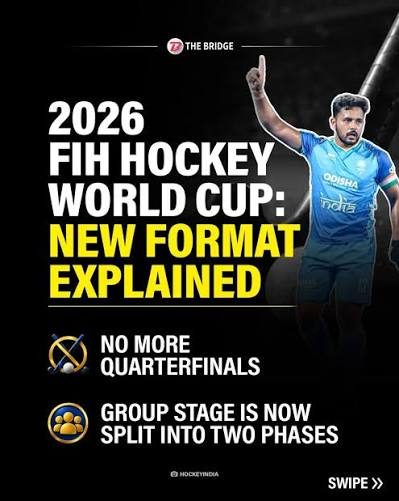
Co-hosted by Belgium and the Netherlands, this 16th edition fundamentally changes how the world champion is crowned. Key structural shifts distinguish the 2026 edition of the FIH Hockey World Cup from every previous edition:
1. Death of the Knockout Quarter-Finals : In every recent World Cup, teams competed in a pool stage, with group winners or crossover winners advancing to high-stakes, single-elimination quarter-finals. In 2026, quarter-finals have been completely eliminated. Instead, the tournament introduces a multi-tiered Crossover Pool System:
Phase 1 (Initial Pool Stage): 16 teams split into four pools (A, B, C, D) playing 3 matches each.
Phase 2 (Crossover Pools): The top two finishers from Pools A & D combine into Pool E, and top two from Pools B & C combine into Pool F. Similarly, 3rd and 4th place teams form Pools G & H for 5th–16th classification.
Head-to-Head Carryover: Results from Phase 1 against the co-advancing team carry over into Phase 2. Teams play 3 additional matches against non-group opponents.
Direct Path to Semi-Finals: Only the top two teams in Pools E and F earn a ticket directly to the semi-finals.
Why it matters: Consistency over single-match luck. Under the old format, a team could dominate its group, have one bad 60 minutes in the quarter-finals, and go home empty-handed. The new model rewards sustained top-level performance across six full matches before reaching the final four.
2. A Historic First: Men’s Co-Hosting & Dual Tournament : While the Women's World Cup was co-hosted in 2022 (Spain and Netherlands), 2026 marks the first time in history that the Men’s FIH Hockey World Cup is jointly hosted by two nations.
Furthermore, both the Men’s and Women’s competitions run simultaneously side-by-side in the exact same host window across two iconic venues:
3. Inclusion Of Inaugural FIH Para Hockey World Cup : To promote disability sport and global inclusivity, the 2026 event embeds the first-ever FIH Para Hockey World Cup directly into the main tournament framework.
Athletes with intellectual disabilities compete on the same international stage and venues alongside the elite men's and women's squads
4. Modernized Qualification Matrix : Previously, qualification heavily favored continental championship winners alongside world ranking play-offs. For 2026, the International Hockey Federation (FIH) linked qualification directly to the year-round FIH Pro League.
Top-ranked teams across the 2023-24 and 2024-25 FIH Pro League seasons secured direct berths alongside host nations and continental champions, creating a transparent, merit-based entry path.
In short, the 2026 FIH Hockey World Cup is defined by its dual-gender, dual-nation staging and a format that prioritises sustained excellence over a traditional knockout intermediate round.
The result is a more continuous competition that keeps more teams involved longer while creating a clearer, results-driven route to the semi-finals and beyond.