
The Election Commission of India has taken decisive action to address significant internal concerns raised by two commissioners regarding voter registration forms, electoral roll database access, and operational transparency, aiming to strengthen electoral processes.
The Election Commission addressed concerns from Commissioners Sandhu and Joshi regarding modifications to Form 6 for new voter enrolment, clarifying its use for SIR exercises.
Concerns about centralised electoral roll database access were met with a decision to review ECINET by an expert committee to ensure compliance and role-based access for field officers.
The EC outlined steps to re-include 97 eligible voters in Goa who were previously left out due to software limitations, directing BLOs to assist with their enrolment.
The Commission committed to circulating agendas and issuing minutes for all meetings, and ensuring meticulous compliance with Commissioners' directions, following concerns about unapproved communications.
The EC clarified that disputed work-redistribution orders within its IT division were never implemented, and the deputy election commissioner's oversight was maintained, addressing concerns about IT governance.
The Election Commission of India has announced a series of decisions on issues that two election commissioners had raised in internal communications over the past 10 months, ranging from changes to voter registration forms to access to electoral roll databases and the functioning of its IT systems.
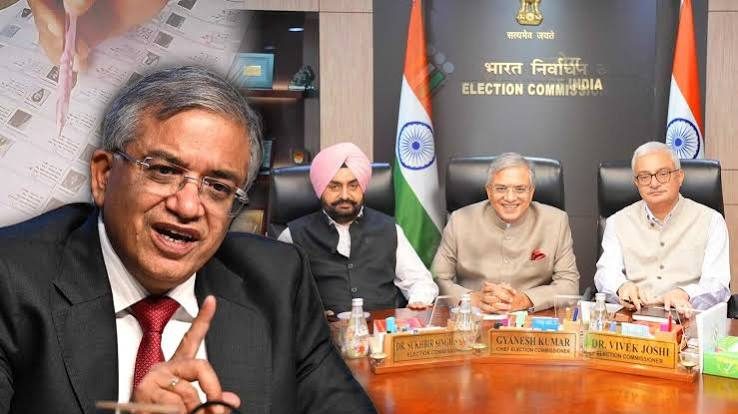
The decisions were taken at a meeting of Chief Election Commissioner Gyanesh Kumar and Election Commissioners Sukhbir Singh Sandhu and Vivek Joshi on Saturday.
The development comes days after The Indian Express reported that Joshi and Sandhu had recorded objections on at least 14 occasions over a 10-month period to decisions and orders, some of which they said were issued without their knowledge.
Here are the key issues raised by the two commissioners and the Election Commission's response or decision:
1. Changes to Form 6
Joshi objected to changes to Form 6, used for enrolling new voters, saying the statutory form prescribed under the Registration of Electors Rules, 1960, could not be modified without amending the Rules. Sandhu concurred with him.
After an SIR-related declaration was subsequently added to the online version of Form 6 on the Election Commission's ECINET platform, Sandhu again objected, saying the statutory form had been altered without amending the relevant rules. He described the change as "unauthorised/illegal" and sought its removal
EC's response: The commission said the additional declaration, which requires new voters to provide details of their own or their parents' or grandparents' entries in the electoral roll prepared during the previous SIR, had been upheld by the Supreme Court. It said the declaration was specific to the SIR exercise and that, outside an SIR, the regular forms prescribed under the Registration of Electors Rules, 1960, would be used.
2. Access to electoral roll database
Sandhu and Joshi had raised concerns over centralisation of the electoral roll database and access to it available to statutory election authorities in states. Joshi proposed an audit to ensure that nobody other than statutory authorities had credentials to make changes to the database, while Sandhu questioned restrictions on access available to state officials.
EC's response: The commission said field officers have role-based access to ECINET according to their statutory powers. A committee headed by a senior deputy election commissioner and including an independent IIT or IIIT expert will review ECINET to "double-check" its compliance with election laws and rules.
Any further flexibility required by field officers will be made operational, it said. New IT modules and portals will also be discussed by the Committee of Officers before approval by the commission.
3. Goa's 97 voters
Following a Supreme Court order, electoral registration officers (EROs) in Goa examined cases of voters flagged for "logical discrepancies" and found 97 eligible for inclusion. However, according to the reported correspondence, the software did not have an option to record the EROs' decision and restore their names.
The Goa CEO's office wrote eight times seeking a rollback option, but the voters remained outside the final roll.
EC's response: The poll panel said BLOs have been directed to visit the left-out voters and collect their forms. Of the 97 voters, 81 have already filled Form 6 for inclusion. The EC has also decided that during the ongoing SIR, BLOs will visit voters issued notices for being unmapped or having logical discrepancies, collect their documents and upload them on ECINET for a decision by the ERO.
Ordinarily, such voters will not have to appear before an ERO or AERO (assistant electoral registration officer).
4. Communications issued without the full commission's approval
Sandhu had flagged communications being issued in the name of the Election Commission without the full commission's approval. Joshi subsequently raised a similar issue and said future communications should receive the requisite approval.
EC response: The press note does not specifically address approval for communications issued in the Commission's name. It said agendas for all Commission meetings will be circulated in advance and minutes issued. It also said all directions issued by Commissioners to EC officers "shall be meticulously complied with".
5. Oversight of IT division
Sandhu and Joshi had written to Cabinet Secretary T V Somanathan over changes in the distribution of work in the EC's IT set-up, raising objections over changes they said were made without their knowledge and affected oversight of the IT division.
EC's response: It said the disputed work-redistribution orders were never implemented after Sandhu and Joshi intervened and that the deputy election commissioner's oversight of the IT division was "never actually withdrawn".
6. Appeals against restoration of voters
Sandhu had raised questions over appeals seeking deletion of voters whom judicial officers had included in the electoral rolls in West Bengal, asking who was authorised to file the appeals on behalf of the EC and who had actually filed them. He recorded that neither he, Joshi, nor the West Bengal CEO had been informed about the basis or process of filing the appeals.
EC response: The September 26 press note does not specifically address these appeals. It said anyone whose name was left out during or after SIR may apply to the ERO for inclusion under continuous updation and directed CEOs, DEOs and EROs to launch a special enrolment drive for such electors.