
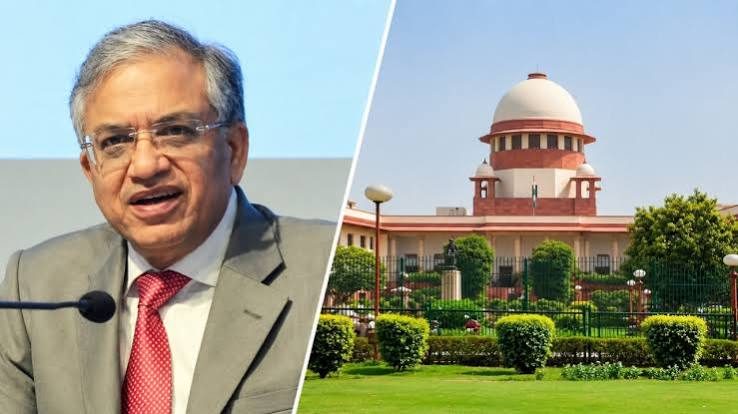
New Delhi : The Supreme Court has issued notices to the Election Commission and the Centre, signalling a critical review of the poll body's decisions.
The Supreme Court has issued notices to the Election Commission and the Centre over allegations of unilateral decisions by the Chief Election Commissioner (CEC).
The court stated it would annul any EC decisions found not to be in accordance with the law, emphasising its power to intervene.
The bench refused an interim order to restrain CEC Gyanesh Kumar from taking decisions, citing concerns about stalling election processes.
The Supreme Court will examine the immunity clause protecting the CEC, noting that even judges do not have such protection.
A petition by Rakesh Kumar Singh alleges the CEC has individually exercised powers belonging to the EC as a whole, seeking to declare such actions unauthorised.
The Supreme Court on Monday issued notices to the Election Commission and the Centre on pleas alleging that the poll body took several decisions without the approval of the two election commissioners and said it will annul decisions found not to be in accordance with law.
The top court, however, refused to pass any interim direction to restrain Chief Election Commissioner (CEC) Gyanesh Kumar from taking any decision till the final disposal of the petition.
Court to Examine Immunity Clause
A bench of Chief Justice of India Surya Kant and Justices Joymalya Bagchi and V Mohana said that it may examine the immunity clause put in the law which gives protection to the CEC even after holding the office.
"We will examine all the decisions. If any decision is not in accordance with the law, we will annul it. You know the power of the court," the bench said as it pointed out that the immunity granted to the CEC is something which even judges don't have.
Senior advocate Vikash Singh, appearing for petitioner Rakesh Kumar Singh, sought a direction in the interim to restrain Kumar from taking any further decisions.
He also sought the CEC's suspension, saying that every citizen is feeling unsafe with respect to voting rights.
The bench also issued notice on a connected petition filed by advocate Shailendra Mani Tripathi and tagged it with Singh's petition.
Concerns Over EC Functioning
The bench said that if the CEC is suspended, the functioning of the Election Commission will be stalled.
"Who will conduct the elections?" the bench asked, adding that the EC has to work in accordance with the constitutional mandate.
Singh submitted that the two election commissioners can discharge the functions. The bench stated that it has to seek the responses of the persons concerned before passing any order.
Singh submitted that the court should then order that the EC should take decisions only unanimously or by majority.
"There is a mandatory law and we expect them to follow it. If there is any violation, we can very well undo it. If there is no unanimity or majority as mandated under the law, then the court can very well annul those decisions," the CJI said.
The bench said it cannot pass any order ex parte and needs to see the decisions taken by the poll panel.
Allegations of Vitiated Electoral Rolls : Singh stated that the electoral roll itself has been "vitiated" because of the unilateral decisions by the CEC. Justice Bagchi then asked whether the court can pass such an order ex parte, without hearing the respondents.
"If records show some decision was not unanimous etc., we will injunct those decisions and say they are ultra vires. Can we ex parte come to a decision that all decisions were unilateral? We expect them to respond in a clear, transparent manner," Justice Bagchi said.
Singh claimed that the press release issued by the EC in the aftermath of the controversy triggered by a news report amounted to admitting to what the article stated. CJI Kant said that the court cannot pass an order by relying solely on newspaper reports and it has to look into the responses of the EC and the Centre.
Background of the Controversy : The Indian Express reported on September 25 that Election Commissioners Sukhbir Singh Sandhu and Vivek Joshi objected on record at least 14 times over the last 10 months to decisions and orders on the Special Intensive Revision (SIR) of electoral rolls that they said were issued without their knowledge or recommendation.
Under fire over the red flags raised by two of its commissioners, the EC asserted that differing views and observations were a normal part of deliberations in any institution and that all its orders carried full legal sanction and followed established statutory procedures.
The bench issued notices to the EC and the Centre on Singh's petition and asked them to furnish all relevant details in their responses.
The top court pointed out that the relief sought in the petition filed by advocate Tripathi is all jumbled up. It asked senior advocate Menaka Guruswamy, appearing for Tripathi, to amend the prayers, if required.
The PIL filed by Singh, a Patna resident, urged the top court to determine whether the CEC has been individually exercising powers that legally belong to the EC as a whole, and, if so, to declare those actions unauthorised and take appropriate legal action.
"Direct that respondent No.3 (CEC) shall not exercise the functions of Chief Election Commissioner of India pending final hearing of the present petition; direct that during such period, the business of the Commission be transacted by the unanimous decision of respondent Nos. 4 (Sukhbir Singh Sandhu) and 5 (Vivek Joshi); and direct that any appointment to the resulting vacancy be made upon the recommendation of a Committee, including the Hon'ble Chief Justice of India," the plea stated.