
NEW DELHI: India has voted in favour of a United Nations General Assembly resolution calling for an end to the US economic, commercial and financial embargo against Cuba, urging Washington to lift restrictions that it says are undermining the that country’s access to essential services.
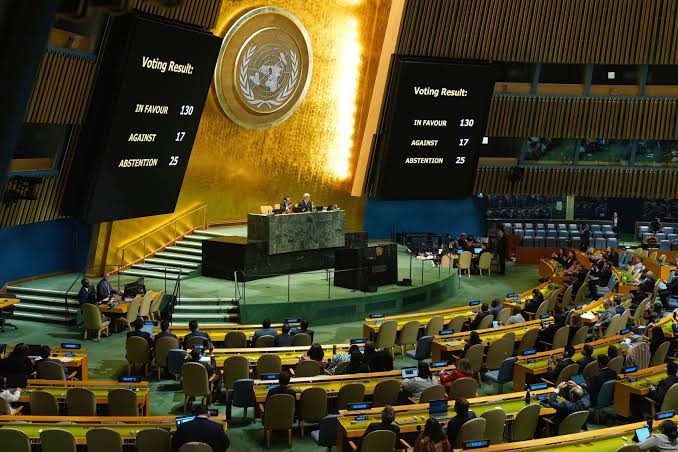
The 193-member General Assembly adopted the resolution on Wednesday, with 130 countries voting in favour, 17 against and 25 abstaining.
Delivering India's statement, Soumya Nair, Counsellor at India's Permanent Mission to the UN, said the Assembly had repeatedly called for an end to the embargo and opposed laws with extraterritorial effects that undermine the sovereignty of other states.
“India reiterates the Assembly's call to all states to refrain from promulgating and applying, and to repeal and invalidate, such laws and measures in conformity with their obligations under the Charter of the United Nations and international law,” she said.
Soumya Nair said India’s position was rooted in its commitment to multilateralism and the belief that international challenges should be addressed through dialogue and diplomacy.
“It is in this spirit that India hopes that the embargo will be lifted at the earliest to help create an environment that would enable the people of Cuba to participate more fully in international cooperation and pursue their legitimate development aspirations,” she said.
Citing a report by the UN Secretary-General, Nair highlighted the impact of the restrictions on Cuba's economy and essential services. She said the country's health system faced shortages of more than 60 per cent of essential medicines, while food production had declined by over 50 per cent in the past five years.
Soumya Nair, counsellor at India's Permanent Mission to the UN.
Cuba says US sanctions blocking its efforts to open economy to private investment
“The restrictions on fuel exports to Cuba have also aggravated the country's ongoing energy crisis. The shortages have disrupted essential services, including healthcare, education, water supplies, food distribution, and transportation,” she said.
The resolution, titled Necessity of ending the economic, commercial and financial embargo imposed by the United States of America against Cuba, reflects longstanding international opposition to the US sanctions. However, General Assembly resolutions of this nature are not legally binding.
The US has maintained an extensive trade embargo against Cuba for more than six decades, following the 1959 Cuban Revolution led by Fidel Castro and the island's subsequent alignment with the Soviet Union.
Havana has consistently blamed the restrictions for worsening its economic crisis, fuel shortages and power blackouts, while Washington has defended its policy as a means of pressuring Cuba's communist government.
The vote came amid heightened tensions between Washington and Havana, following a confrontation on Tuesday between US Ambassador to the UN Mike Waltz and Cuban Foreign Minister Bruno Rodriguez Parrilla during a General Assembly session.
As Waltz addressed the assembly on Cuba, Parrilla and other Cuban diplomats left their assigned seats and approached the podium, triggering a heated exchange that forced the suspension of the meeting. Waltz stepped away from the lectern and gestured for the Cuban foreign minister to move back.
The US envoy later accused Cuba's leadership of hypocrisy, alleging that its officials enjoyed luxury goods and private properties while ordinary Cubans faced hunger and power shortages.