

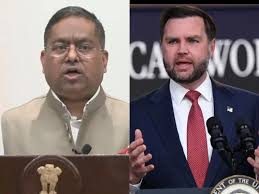
NEW DELHI: India on Friday termed US Vice-President JD Vance’s remarks on foreign workers “unwarranted” and “deeply offensive,” asserting that Indian professionals make significant contributions to the American economy, innovation and job creation.
New Delhi also said the US decision to suspend Permanent Labour Certification (PERM) applications for certain companies does not advance the shared ambitions of the two countries.
“Talent mobility is of tremendous mutual benefit for the two countries and our expectation is that all stakeholders in this process can appreciate this fact,” the External Affairs (MEA) said.
“The steps announced by the US do not advance the shared ambitions of both countries,” said the MEA.
The response came after the US suspended new PERM applications and halted the processing of pending applications for eight companies, including Microsoft, Adobe and Capgemini, as well as Indian IT firms Cognizant, Infosys, Tata Consultancy Services (TCS), Wipro and HCL.
The move is part of the Trump administration’s wider push to tighten employment-based immigration, with officials arguing that companies should prioritise American workers. Vance accused Microsoft of using the programme to replace American employees with foreign workers.
Rejecting the characterisation of foreign professionals as “foreign indentured servants,” the MEA said such descriptions ignored the contribution of Indian workers to the US economy and innovation ecosystem.
“Resorting to terminology that carries painful historical and colonial legacy connotations is deeply offensive,” the MEA said and highlighted the role generations of immigrants have played in America’s economic growth and prosperity.
The suspension affects the PERM programme, a labour-certification process that US employers generally need to complete before sponsoring eligible foreign employees for employment-based Green Cards. Introduced in 2005, the programme requires employers to establish that there are not enough qualified and available US workers for a position and that hiring a foreign worker will not adversely affect the wages and working conditions of similarly employed Americans.
For Indian professionals employed by the affected companies, the suspension could delay a key route to permanent residency. Many skilled workers enter the US on temporary H-1B visas before seeking employer-sponsored Green Cards. Disruption to the PERM process could leave eligible employees waiting longer for permanent residency and make US employment less attractive to some international recruits.
The MEA, however, clarified that PERM is separate from the H-1B visa programme and that the suspension does not, by itself, affect existing H-1B visas or the status of their holders and dependants.
“While it creates opportunities for Indians, it equally helps US companies with cutting-edge talent, innovation, research, productivity, competitiveness and job creation, besides creating shareholder wealth in the US,” the ministry said.
The latest action follows the Trump administration’s broader efforts to restrict skilled immigration, including its announcement of a one-time $100,000 fee on new H-1B visa petitions. The fee has faced legal challenges, adding to uncertainty surrounding US immigration policy.
India maintained that skilled migration benefits both countries and called on stakeholders to recognise its economic contribution.
The dispute highlights the challenge of balancing US domestic employment priorities with the technology sector’s reliance on international talent and the broader economic ties between Washington and New Delhi.