
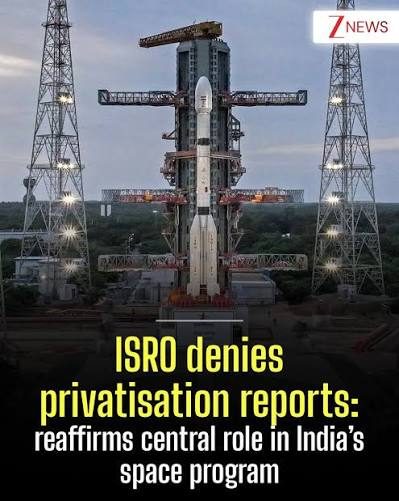
Bengaluru / Sriharikota : The Indian Space Research Organisation (ISRO) on Sunday strongly rejected reports and speculation that ongoing space-sector reforms could lead to its privatisation or a reduction in its role, asserting that it will continue to remain at the centre of India’s space programme.
In a detailed post on X, the space agency said there had been considerable media reporting about its future role, including claims that efforts were underway to privatise ISRO or diminish its importance.
“These assertions are completely baseless and incorrect,” ISRO said, making it clear that the organisation “will neither be privatised nor will its importance be diminished”.
The agency said ISRO will continue to be India’s principal institution for advanced space research and technology development, national and strategic missions, space science and exploration, as well as critical and frontier space capabilities.
At the same time, ISRO said the growing participation of private companies in the space sector should not be viewed as an attempt to reduce its responsibilities.
Instead, the reforms are aimed at allowing ISRO to concentrate more deeply on next-generation technologies and complex missions, while industry takes mature technologies and capabilities to a larger scale.
“What is changing is not the importance of ISRO, but the scale and structure of India’s space ecosystem,” the agency said.
The space-sector reforms, which began in 2020 and were institutionalised through the Indian Space Policy 2023, along with the progressive liberalisation of the Foreign Direct Investment (FDI) policy, are aimed at building a larger, stronger and globally competitive space ecosystem.
Under this framework, industry, startups and academia are being encouraged to participate across the space value chain. ISRO said their involvement would complement and multiply its own capabilities, making the reforms an exercise in ecosystem expansion and capability multiplication rather than privatisation.
The agency also pointed out that it has already transferred multiple technologies to industry. As India’s industrial and technological capabilities expand, mature and scalable activities can increasingly be handled by Indian companies.
ISRO stressed that transferring a mature technology to industry does not mean it is withdrawing from that particular area. Instead, it allows companies to undertake large-scale production and commercialisation, drive innovation and gain access to global markets, while ISRO’s scientific and technical workforce can focus on advanced research, emerging technologies and complex national missions.
The agency described this evolving model as an “ISRO-led national space ecosystem”.
Under this approach, ISRO’s role is expected to become even stronger in areas where its scientific and technological expertise is most critical. These include frontier research and development, advanced technologies, human spaceflight, next-generation launch systems, deep-space and planetary missions and strategic national capabilities.
ISRO will also continue working on cutting-edge technologies, including advanced payloads for communication, navigation and Earth observation, along with sensors, propulsion systems and other critical technologies.
At the same time, mature and routinely manufactured systems can increasingly be produced by industry or public sector undertakings (PSUs) through appropriate competitive processes. This includes mature launch vehicles, routine satellites and other established systems.
According to ISRO, such a division of responsibilities will allow it to dedicate greater resources and scientific manpower to developing the next generation of technologies and missions, while the wider ecosystem brings in the investment, manufacturing capacity and scale needed to support India’s expanding space programme.
India’s long-term space ambitions include establishing the Bharatiya Antariksh Station by 2035, sending an Indian crewed mission to the Moon by 2040, developing next-generation and reusable launch systems, pursuing sustained lunar and planetary exploration and establishing the country as a major global space power.
ISRO said achieving these goals would require sustained focus on advanced research and capabilities that cannot simply be replaced by commercial activity.
“The objective is, therefore, to enable industry to scale mature capabilities while ISRO pushes India towards the next technological frontier,” the agency said.
The space agency also highlighted the rapid growth of India’s private space sector since the reforms were introduced in 2020.
From only a handful of Indian space startups in 2020, the country now has more than 450 startups operating across areas such as launch vehicles, satellites, propulsion, ground systems, Earth observation, communications and space applications.
ISRO said India’s space economy is currently estimated at around $8.4 billion, which remains a relatively small share of the rapidly expanding global space economy.
India has set a target of increasing its share of the global space market to $44 billion by 2033. ISRO said achieving that scale would not be possible through government resources and its own manpower alone.
It would require a combination of private capital, industrial capacity, entrepreneurship and access to global markets.
The agency’s clarification comes as India continues to expand private participation in the space sector, with ISRO emphasising that the reforms are intended to broaden the country’s space capabilities while keeping the organisation firmly in the lead on advanced and strategically important missions.