
Hyderabad: 'Frankly, I'm in that zone for another Olympics.' 'My father gave me the most impactful career advice: No win is big enough to stop training for another.'
'It's different when you start playing. You're in your teens, the body is automatically recovering. Now, you have to track it, and act immediately if it doesn't recover on its own'.
'There were people who came before me, who played really well for the country. What changed for me was the recognition and how the badminton ecosystem was evolving.'
I open Google Maps on my phone to check the distance from Whitefield to Tharahunise. It is 40 km -- a nearly 1.5-hour drive.
For a conversation scheduled at noon, I leave by 9:30 am because "I got stuck in the Bengaluru traffic" cannot be my ice-breaker with a two-time Olympic medalist, P V Sindhu.
On reaching, I'm told Sindhu is just wrapping up her post-training session. So I wander around the venue: The Centre for Sports Excellence -- a 24-acre multisport facility where celebrated athletes such as shuttlers Lakshya Sen and Ayush Shetty, wrestler Vinesh Phogat, and swimmer Srihari Nataraj also train.
And where veterans like Rahul Dravid, Abhinav Bindra and Rohan Bopanna can be routinely spotted mentoring children for international events.
I eventually settle down at Square Burgers and Co, a cafe in the complex opposite the badminton academy.
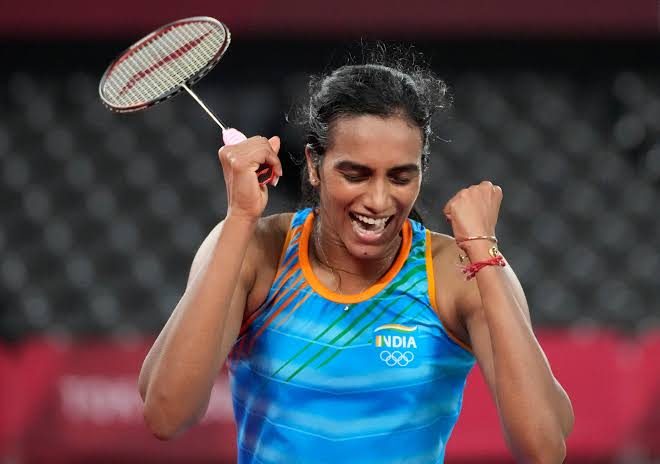
Ten minutes later, I spot her, striding out of the training zone, her badminton kit on her shoulders, which also carry the pride of a glorious international career of 15-plus years.
The Bengaluru weather allows us to sit outside -- pleasant, but also prone to interruptions, given how her admirers keep dropping by.
"I enjoy it," she says about the requests for pictures with her.
"After all, we've all been fans at some point or the other," she says.
She, for one, likes how Cristiano Ronaldo and Roger Federer trained and played. "It's inspiring to watch them".
Her biggest role models, though, are her parents, both volleyball players.
"Until Covid, my dad travelled with me on all the tours," she says.
"He gave me the most impactful career advice: No win is big enough to stop training for another."
That's something every journalist can relate to. After all, we're constantly reminded: "You're only as good as your last story."
She suggests we first order the food. After poring over the menu, the athlete sticks to protein.
"It's all very tempting, but I'm currently on a strict diet," she says, choosing a teriyaki chicken bowl with rice. I ask for a Korean bun with classic Americano.
I ask her what her cheat-day favourites are. "You should ask me what aren't," she replies, laughing.
I'm reminded of an image she posted on social media from the recent Uber Cup with this caption: 'Two matches in two hours. And my body politely reminding me that I am not 19 anymore. Glad to win both.'
"Well, I've crossed 30 now," says the five-foot, 11-inch shuttler who turned 31 on July 5. (I appear a midget standing with her in the picture I later get clicked.)
"It's different when you start playing. You're in your teens, the body is automatically recovering. Now, you have to track it, and act immediately if it doesn't recover on its own." she says.
There was a time she trained for four-five hours at a stretch.
"But now it has to be smart training, even if it's a 45-minute session that does the job," she says.
That's where sports science comes in. Speaking of which, my gaze again turns to the gadget on her temple. I've been a wee bit distracted by it.
The device is called, well, Temple, and it helps track key metrics -- such as cerebral blood flow and heart rate variability -- both on and off the court.
Developed by Zomato Founder Deepinder Goyal, it is in a testing phase and not for sale yet. "It's working well, so far," she says.
While Sindhu's achievements look extraordinary today, she picked up the racket like any other child. The early wins brought with them the hunger for more: Under-10, under-13...
"There was no reason to stop."
She transitioned to the international senior circuit in 2011 at age 15.
"Being the youngest in the group, I got an early opportunity to closely observe everybody that I admired -- how they prepared, their mindset."
The first senior-level tournament win also came at 15: Maldives International Challenge. Other wins and appearances in the finals announced the arrival of a new badminton star.
As I bite into the Korean bun, she takes another look at the menu before choosing between Spanish latte and Vietnamese iced coffee.
The iced coffee makes the cut. We go back to milestones. What's her favourite win?
This time, the choice is tougher and the contenders many.
"They're all special," she says, "but I think my 2012 win against Olympic gold medalist Li Xuerui was a breakthrough moment. Besides what it meant professionally, it made me believe I could win an Olympic medal."
She did -- a silver at Rio (2016) and a bronze at Tokyo (2020), making her the only Indian shuttler to win two consecutive Olympic medals.
"In 2016, I was an underdog," she says. "It was my first Olympics. Nobody expected much, and there I was, playing the final."
Three years earlier, she'd won a bronze at the World Championship in Guangzhou, China -- the second Indian after Prakash Padukone's bronze in 1983.
She has won five World Championship medals in all, including a gold in 2019. Another Padukone comes up in our conversation.
This time, on the question of a possible biopic after she retires. She'd like Deepika Padukone to portray her. "Else, I'll do it," she laughs.
I have only been nibbling at my bun since her chicken bowl is taking forever to arrive. It finally arrives and we pause as she digs in.
"You should also try their Vietnamese iced coffee," she suggests.
Already halfway through my hot Americano, I reply, "Next time," but instantly become aware of the rarity of this opportunity.
Her response is unapologetic: "Yes. There were people who came before me, who played really well for the country. What changed for me was the recognition and how the badminton ecosystem was evolving."
On the pressure, she says she has learnt to deal with it. Some three years ago, for instance, she slipped from the World Top 10 ranking, but shuttled her way back to the list in the recent Indonesia Open.
She's confident about her form and has her sights set on the 2028 Olympics in Los Angeles.
"I am injury-free and coming at the top of my game," she says. "Frankly, I'm in that zone for another Olympics."
That said, she is well aware of the probable heartbreaks that can happen on court, but has matured as a player.
"A younger Sindhu would have been frustrated. Now, maybe, I am more analytical."
"To begin with, you start listening to your coach more," she says.
Then there's the strong mental space that an athlete develops over the years, especially since this is a career where setbacks are usual and wins an exception.
On the personal front, not very many women athletes are known to wed while at their peak. She bucked that trend by marrying entrepreneur Venkata Datta Sai in December 2024.
"A happier person plays a better game," she smiles, looking up from her rice bowl, which she's clearly relishing.
I bring up a viral tweet from New Zealand cricketer Jimmy Neesham, which read: 'Kids, don't take up sport. Take up baking or something. Die at 60 really fat and happy.' He posted it after the team lost in the 2019 World Cup final.
Even before I can complete my question on any such regrets, she starts shaking her head.
"There've been really bad days, but not once have I felt like not showing up," she says.
Badminton for her is her "safe space". "It's my passion."
Which is why she's never had an answer to "What if not badminton?". There's never been a plan B, she says.
Badminton is a fast-paced game and the competition is intense. In the long list of tough competitors, is there a leader, I ask.
All the top ranking ones are and they leave no scope of mistake, she replies.
"But then everyone is beatable." That's been her steady -- and winning -- approach.
However, some sporting rivalries are written in history. Sindhu versus Carolina Marin is one of them. As I bring it up, a smile appears on her face.
"The nature of the game has evolved. Earlier, it was aggressive and faster. Having said that, yes, I think she was my biggest competitor," she says.
Sindhu is no stranger to the changing dynamics of the game. "It has gradually shifted to being more strategy-driven," she says.
For her, this means being able to build longer rallies and knowing how to spend more time on the court.
More so now, with a new 15-point rule coming in, which may bring a sudden speed into the game.
The rule, to be introduced from January 2027 globally and July 2026 in India, will make the sets shorter from the current 21-point rule.
"You won't have many points to recover if you concede early. So, it will be a fight from the word go," she explains.
Sindhu was recently appointed chair of the Badminton World Federation's Athletes' Commission, which means she's at work even beyond her game.
"You are dealing with other high-class athletes, listening to their concerns, looking at the tournament arrangements, and checking if the facilities are up to the mark," she says.
Closer home, things have changed for the better for the sport, but a lot of ground remains to be covered. Some initiatives such as the Premier Badminton League, had shown promise.
The league was launched in 2016 but didn't quite take off, and fizzled out by 2020.
If leagues such as these return, they could really help tap grassroot-level talent, she says.
"Badminton is an individual sport, and you need such events to come out of your bubble," she says, speaking from experience.
During the upcoming September-October Asian Games, her fourth, she is looking forward to guiding emerging talent such as Tanvi Sharma and Unnati Hooda, who are part of the squad.
"At a personal level, I am also looking forward to a medal this time," she says.
It's been quite a year for her already -- for reasons other than badminton as well.
This February, she and her coach were travelling from Bengaluru to Birmingham via Dubai to play the All England Open Badminton Championship when, suddenly, the Dubai airspace was shut. The Gulf war had broken out.
"First, we were told that the flights were delayed. Then they started to cancel all the flights," she recalls.
She couldn't believe it was due to a war until she saw the news and started getting phone calls from home.
As soon as flights resumed, she returned to Bengaluru, skipping the tournament.
Now on the other side of 30, Sindhu knows her active playing years are numbered, but she does not intend to move away from badminton.
"When you have played a sport for 20-odd years, you know it in and out. I want to pass on that knowledge," she says.
So, she's building a Centre of Badminton and Sports Excellence in Visakhapatnam. It will be a multisport training academy.
"We need a lot more Sindhus," she says.
"Is it even possible to have more Sindhus?"
I blurt out in a fan-girl moment. The sportsperson looks me in the eye, and replies: "Hopefully, yes."