
Islamabad : The captain of the Pakistani naval ship was overconfident, reckless and professionally incompetent. He displayed false bravado and by his actions would have caused grievous injuries to his men onboard and severely damaged the ship.
On the other hand the captain of INS Kolkata maintained his cool, composure, displayed excellent seamanship skills and maintained his course and speed to avoid a major catastrophe.
Comparison of the two captains shows the levels in professional competence of the two navies which are miles apart, points out Commodore Venugopal Menon (retd).
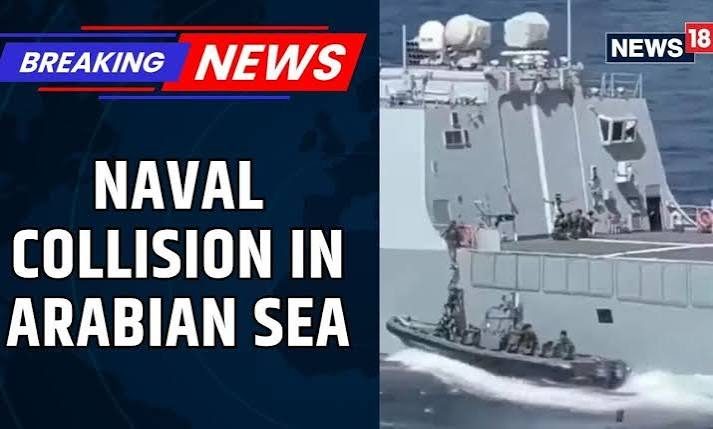
PNS Hunain and INS Kolkata came into contact in the North Arabian Sea on September 15 during naval operations.
The Pakistani vessel sustained damage and returned to port, while INS Kolkata continued its operational deployment.
Close-quarters manoeuvring can create dangerous pressure, suction and hydrodynamic forces between ships.
Adherence to rules of engagement helped prevent the incident from escalating into a larger confrontation.
The media has been on an overdrive following the recent incident of a Pakistan naval ship attempting to shadow and shoulder an Indian naval ship which was on operational deployment to escort Indian ships coming out of the Gulf of Oman in the North Arabian Sea on September 15, 2026.
In a dramatic development on the high seas, Pakistan naval ship PNS Hunain was involved in a minor collision with the Indian Navy Destroyer INS Kolkata in international waters on September 15.
The collision resulted in a dent on the ship side of the Pakistan navy ship which has returned to port for repairs. INS Kolkata continued with its operational deployment after the incident.
This act was in direct contravention of Article 10 of the India Pakistan agreement on advance notice on military exercises, maneuvers and troops movement of April 1991.
The referred article stipulates naval ships and submarines must stay at least 3 nautical miles away from each other in open waters to prevent incidents at sea.
Although Pakistan claims that their biennial naval exercise Sea Spark was in progress and INS Kolkata was in that area.
The point to note is that the area was not designated as restricted to shipping traffic which is normally done for live firing during naval exercises.
The Pakistan navy ship had approached INS Kolkata at high speed while attempting to intercept it, lost steering control resulting in the two vessels grazing each other.
INS Kolkata's captain had issued warnings to PNS Hunain which were ignored by the Pakistani ship.
PNS Hunain is a sophisticated multipurpose Corvette equipped with excellent navigation and communication systems which clearly shows that this act was deliberate and it was not because of failure of any systems onboard.
The ship was built by Damen Shipyards of The Netherlands and was commissioned in 2024.
The vessel measured about 98 metres in length and is a highly maneuverable versatile combat platform. The dangerous maneuver by PNS Hunain can be seen through the following dimensions:
Shouldering is an aggressive maritime maneuver where one ship steers extremely close to another ship at sea and uses its hull to physically push, herd, or force the other ship to change course.
Close Quarters: The maneuvering ship pulls up right alongside or slightly ahead of the target vessel.
Bow Control: The attacking captain tries to keep their bow ahead of the other ship's 'bow'.
Forced Turn: The physical presence and hydrodynamic pressure force the target ship to turn away to avoid a collision.
Skin to Skin Contact: Ships sometimes make physical contact, scraping hulls or causing minor structural damages without firing any weapons.
During the 1980s, Soviet warships used this tactic to push US naval ships out of claimed territorial waters during freedom of navigation exercises.
The famous example is the 1988 Black Sea bumping incident which involved a US Cruiser USS Yorktown and destroyer USS Caron who were exercising the right of innocent passage through Soviet territorial waters in the Black Sea during the Cold War period.
The ships were deliberately shouldered by two Soviet Frigates with the aim of pushing them into international waters. The incident happened on February 12, 1988.
Today, large Chinese coast guard ships and maritime militias particularly in the South China Sea use reinforced hulls to shoulder foreign or rival law enforcement boats without crossing the threshold into outright military warfare.
The Pakistani ship was trying to shoulder INS Kolkata. However, the Pakistani ship lost control of the steering due to high speed and pressure and suction effect which resulted in grazing of both the ships which is less severe than a collision.
Bow Cushion (High Pressure): As a ship moves forward, it pushes water ahead of it.
When two ships approach or align closely, the high-pressure bow zones push against each other, causing the bows to repel or swing away initially.
Water rushing through the narrow gap between the two side by side ships speeds up. According to Bernoulli's Principle, higher water speeds drop the static pressure.
This low-pressure zone acts like a vacuum creating a suction effect that draws the hulls bodily towards each other.
Stern Suction: As the ships begin to clear each other, extreme low pressure builds around the stern quarters.
This pulls the sterns together, which can lead to a collision if the helm is not adjusted.
The Four Phases of Passing or Overtaking
High pressure bow zones repel resulting in the ships to push away from each The narrow space speeds up water flow, creating strong suction that draws the midships and bows/sterns dangerously close.
Overlapping/Passing: Mutual attraction peaks as low pressure areas pull the ships toward a potential broadside crash or stern smash.
Clearing: The trailing sterns experience sudden pull, requiring precise counter helm maneuvers to regain a straight course.
I have briefly explained the complexity of hydrodynamic forces affecting ships maneuvering at close quarters.
It does not require rocket science to surmise that the captain of the Pakistani naval ship had ignored these basic factors, was overconfident, reckless and professionally incompetent. He displayed false bravado and by his actions would have caused grievous injuries to his men onboard and severely damaged the ship.
On the other hand, the captain of INS Kolkata maintained his cool, composure, displayed excellent seamanship skills and maintained his course and speed to avoid a major catastrophe.
Comparison of the two captains shows the levels in professional competence of the two navies which are miles apart.
Every Indian naval ship on deployment adheres to the prescribed rules of engagement to be followed in different situations which has the approval of the Government of India.
In this case, the captain adhered to the rules of engagement in toto displaying excellent professional competence and navigational skills.
The Indian media has gone ballistic drawing some clueless panelists to talk on the subject.
Many of them described the inaction by the captain of INS Kolkata as meek surrender to the senseless action by the Pakistani ship.
Some even suggested that the Pakistani ship should have been attacked in retaliation and sunk, totally unaware of the diplomatic repercussions and how such action could have escalated the matter leading to total war.
It is apparent that they were comparing to the firing across the Line of Control wherein firing from across the border is retaliated in full measure by the other side.
I have highlighted the likely errors made by the Pakistani ship, which were due to professional incompetence, lack of basic seamanship knowledge, recklessness, over confidence and extremely poor judgement.
Excellent display of professional knowledge and good judgement by the captain of INS Kolkata prevented a catastrophic accident at sea.
In this connection, I would reiterate that there is no need to be reactive or jingoistic or revisit the rules of engagement and existing confidence building measures.
Captains of Indian Navy ships are selected on merit and competence. They can be fully trusted to deal with all situations at sea professionally and in the best traditions of the Indian Navy.
Commodore Venugopal Menon served in the Indian Navy for 29 years in operational roles, including commands at sea, and training and staff assignments at Naval HQ. In addition to the staff and war courses in the Indian Navy, he underwent the executive course at the Asia Pacific Centre for Security Studies, Honolulu.