
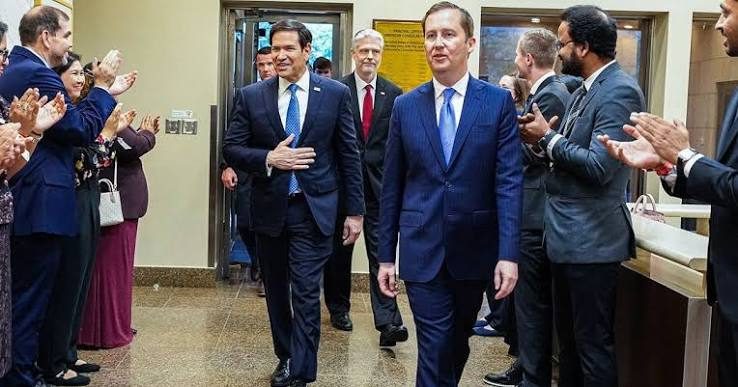
NEW DELHI: As part of his efforts to encourage Indian refiners to buy more Venezuelan crude, US Secretary of State Marco Rubio on Wednesday visited Reliance Industries (RIL)’s oil-refining complex in Jamnagar, Gujarat.
On Tuesday, Rubio had said Indian refiners should process more Venezuelan crude oil.
In Jamnagar, Rubio and his entourage including US Ambassador Sergio Gor were welcomed by RIL chairman Mukesh Ambani, his wife Nita, and their children Isha and Anant.
They were given a tour of the refinery complex and were briefed on Reliance’s new energy giga-factories, RIL said in a statement. “The visit included discussions on the global energy landscape and opportunities for commercial partnerships across conventional and new energy.”
RIL’s Jamnagar facility is the world’s largest single-site oil refining complex with a combined processing capacity of 1.4 million barrels per day. The firm has a total refining capacity of 68.2 million tonnes per annum.
Rubio also met business leaders Gautam Adani and Tata Sons chairman N Chandrasekaran in Mumbai on Wednesday.
All literary awards serve as signals of quality. They have their curatorial emphases and specific ambitions. Words that last, writers who take the job of imagination seriously, mark it with integrity, and speak in a unique voice, capturing attention in a crowded world of content.
The Ramnath Goenka Sahithya Samman (RNGSS), instituted in honour of Ramnath Goenka, a stalwart of Indian print media and founder of The New Indian Express Group, returns for its fourth edition with a sharper aim.
Comprising Santwana Bhattacharya, Editor, The New Indian Express Group; K Vaidyanathan, Editor, Dinamani; and Ravi Shankar, Consulting Editor, Sunday Magazine.
Books published between July 2025 and June 2026 were considered for the longlist across three categories—Fiction, Non-Fiction and Debut.
The fourth category, the RNGSS Lifetime Achievement Award, honours distinguished literary figures whose contributions have enriched Indian literature over the course of their careers.
In the Best Fiction shortlist are Amitav Ghosh’s Ghost-eye, a climate-crisis novel that is about families, food and marginalisation; Rahul Bhattacharya’s Railsong, about a woman who grew up in an Indian railway township against the backdrop of a nation in motion, as steam engines gave way to diesel and India passed through the tumultuous 1970s;
Geetanjali Shree’s Once Elephants Lived Here, an unsettling short story anthology of people caught in their pasts; and Ashwin Sanghi’s Ayodhya Alliance, a cross-cultural story in which an Indian industrialist and a South Korean technocrat uncover an ancient metallurgical force.
Four books are part of the Best Non-fiction list. They are: Abhishek Choudhary’s Believer’s Dilemma — Vajpayee and the Hindu Right’s Path to Power, 1977-2018, a mapping of the Hindu Right movement from the margins to a party of power, and its first prime minister;
Raghu Palat and Pushpa Palat’s God’s Own Empire, a dramatic period novel about Marthanda Varma, the first monarch of Travancore; Ghazala Wahab’s
The Hindi Heartland, a book that debunks the idea of the region as a monolith, arguing for its plurality in history, culture and politics and the way to reclaim its diverse roots; and Shaan Kashyap’s Who Owns the Past, on the official histories of colonial to modern India and the historians who wrote them.
The contenders for the Best Debut award are: Never Logged Out — How the Internet Created India’s Gen Z by Ria Chopra on the constantly ‘connected’ generation; Mohsin Khan’s Allah Miyan’s Workshop on the doubts and disquiet of a Dickensian boy hero; Ponnu Elizabeth Mathew’s The Remnants of Rebellion, about a Syrian Christian family of Kerala in the backdrop of caste oppression and emerging Hindu nationalism; and Sowmiya Ashok’s The Dig: Keeladi and the Politics of India’s Past, on the archaeology of Keeladi, its centrality to the storytelling about Tamil Nadu and the politics of presenting competing stories about the past.
A jury meeting in Delhi, comprising the external and internal jury, will choose the winners from the shortlist on October 22. Chaired by author and parliamentarian Shashi Tharoor, the external jury includes economist Sanjeev Sanyal and author-historian Vikram Sampath. The winners will be announced at a prestigious award ceremony in Chennai, the TNIE headquarters, on December 2.