

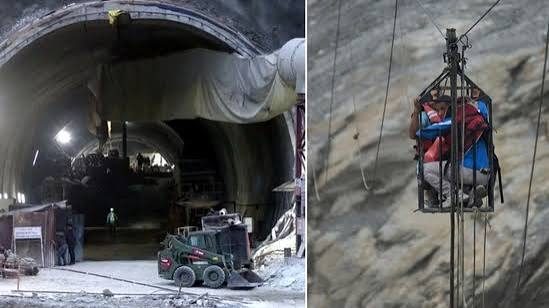
Khatmandu : Australian tunnel expert Arnold Dix, who successfully led the Silkyara tunnel rescue, is now applying his invaluable experience and the principle of "never confuse unlikely with impossible" to complex flood search-and-rescue operations in Nepal.
Australian expert Arnold Dix, famed for the Silkyara tunnel rescue, is leading complex search operations in Nepal.
Dix is applying lessons from the Silkyara operation, emphasizing "never confuse unlikely with impossible" in rescue efforts.
The Nepal mission involves multiple potential rescue sites simultaneously, posing unique challenges compared to Silkyara.
Indian and Nepali technical teams, including personnel from the Silkyara rescue, are collaborating under difficult conditions.
The operation highlights the discipline, compassion, and duty required in uncertain rescue scenarios.
Australian tunnel expert Arnold Dix, who helped rescue 41 workers from India's Silkyara tunnel in 2023, drew on that experience on Monday as he continued a complex search-and-rescue operation in Nepal, saying the effort has taught him "never to confuse unlikely with impossible".
The Australian expert arrived in Nepal on Saturday to assist the search for people believed to be trapped inside the Chilime hydropower tunnel following devastating floods along the Bhotekoshi River on August 26.
Dix has been working alongside Nepali and Indian experts to assess the tunnel and revise plans to reach the underground powerhouse, where people are believed to have possibly taken refuge.
Applying Silkyara Lessons To Nepal's Challenges : The search at Chilime is part of a wider rescue operation following catastrophic flooding along the Bhotekoshi-Trishuli corridor in Nepal, which has left hundreds dead and thousands missing.
Dix said the situation in Nepal had reminded him of the Silkyara operation in Uttarakhand, where 41 construction workers were trapped underground after a portion of the tunnel collapsed in November 2023. They were rescued alive after spending 17 days underground in a multi-agency operation that swung between hope and despair.
"We had one seemingly impossible task: bring them home alive. We passed that test together," Dix said in a post on X on Monday referring to the 2023 rescue.
At Silkyara, rescue workers eventually reached the trapped men through a 60-metre escape passage after rat-hole mining experts manually dug through the final stretch of rubble. The workers were taken out one by one through a steel chute and rushed to hospital.
Complexities Of Multiple Rescue Sites : Dix said the Nepal operation was different because rescuers were dealing with several possible rescue sites at the same time.
"Not one rescue -- but multiple potential rescues, unfolding at the same time, in different places, each with its own dangers, uncertainties and lives that may still be saved," he wrote.
Reflecting on his Silkyara experience, Dix said that completing one difficult rescue successfully did not mean the testing was over.
"Silkyara taught me never to confuse unlikely with impossible," he said.
Dix said Nepal was facing a challenge unlike any he had encountered before, with multiple potential rescues unfolding simultaneously at different locations.
International Collaboration In Difficult Terrain : The operation has also brought Dix back together with some of the Indian personnel he worked with during the Silkyara rescue, including Colonel Parikshit Mehra, who is leading the Indian Army and National Disaster Response Force team deployed at the Nepal site, The Kathmandu Post newspaper reported.
Indian Ambassador to Nepal Naveen Srivastava said on Sunday that the Indian and Nepali technical teams were continuing work inside the Chilime tunnel despite difficult access, slush and heavy debris.
"Despite challenging conditions of limited & poor access, slush and heavy debris, the Indian & Nepali joint technical team continue to make progress in the tunnel with hard manual work," Srivastava said in a post on X.
The teams have also started establishing rope connectivity from Syafrubesi to the tunnel to facilitate the induction of more personnel, while work on a temporary road towards the tunnel is progressing, with around 950 metres cleared, he said.
The Philosophy Of Rescue Operations
Dix said the Nepal operation was also a test of the willingness of rescue teams to continue working despite uncertainty over the outcome.
"Hope must become discipline, compassion must become action, and duty cannot depend upon certainty of success," he wrote.
Dix concluded by saying that the principle of rescuing those in danger remained the same across cultures.
"We are measured not only by the lives we save, but by the lives we refuse to abandon," he said.