
New Delhi : 'People always see the glamour associated with IAS officers but it is a highly challenging profession, especially in today's multimedia era, where everything is put under a scanner.'
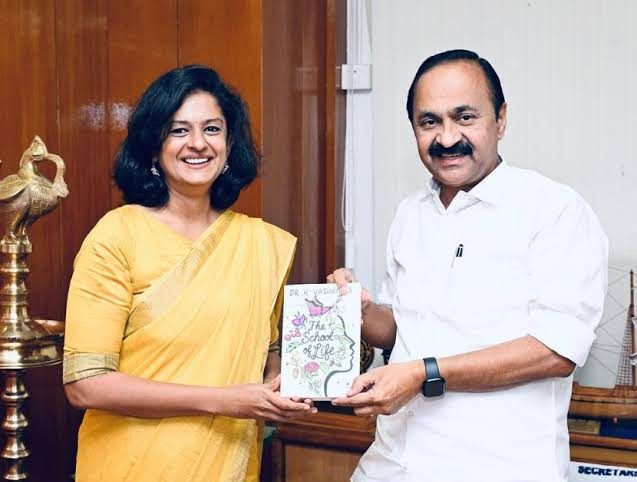
Dr K Vasuki, author of The School of Life with Keralam Chief Minister V D Satheesan. Dr K Vasuki presents a copy of her book The School Of Life to Keralam Chief Minister V D Satheesan. Photograph: Kind courtesy Dr K Vasuki/Instagram.
After building a career in the Indian Administrative Service, Dr K Vasuki spent years reflecting on life's many contradictions -- ambition and contentment, success and happiness, material wealth and inner peace.
It took her two years to turn her personal journal into The School Of Life. The book, says Dr Vasuki, is not intended to be a self-help guide or a set of instructions on how to live your life. Instead, she draws on her own experiences, vulnerabilities and learnings to encourage readers to look within and understand themselves better.
"The entire point of the book is that, only when you start acknowledging the pain and negativities within you, can your life change," Dr Vasuki, who is currently serving as secretary in Keralam's general education department, tells Rediff's Divya Nair in a telephone interview.
"I was very clear that it should not be about standing on a high pedestal and advising people but more about sharing my experience," adds the Chevening Scholar and a university gold medallist who completed her MBBS degree from the Dr MGR Medical College in Tamil Nadu and master's degree in psychology from the University of Reading in the United Kingdom.
Book cover of The School of Life by Dr K Vasuki IASThe book (pictured left) started as a personal journal because there was a point in time when I felt my life was demanding a lot of looking back and introspection. When I started writing, a lot of revelations come to me. I was meditating as well.
As I kept writing, I had to research more. I started talking about what I had understood at workshops and talks and the response from people was really amazing.
Discussions with my husband and his perspectives deepened the search I was having in my mind,
That's when I thought, whatever I'm writing, let me turn it into a book. Even while writing, I wasn't sure whether it would be received in the right sense.
Some people who read the book were concerned about whether people would understand it and whether so many revelations were necessary.
But then I felt, let it go out. Even if it helps a few people, it's still worth it.
The kind of response I'm getting right now was not expected. I feel people love the honesty and the unique perspectives in the book.
What is the best or most unexpected compliment you've received for the book?
Many people who read the book said it completely changed the way they look at life.
Much of the time today, commercial and materialistic interests define what life is all about. Many of us do not know the truth or the nature of life.
Another compliment is that readers have found answers in the book to questions they had been facing but perhaps didn't have the time to explore.
I was expecting all kinds of responses because I know what is being discussed is against the tide. I was expecting a mixed response but, largely, it has been positive.
It's not easy to talk about your ego, insecurities or weaknesses and bare yourself to the world. How did you convince yourself to put yourself out there without worrying about how people would perceive you?
I was very clear about it. This is what I keep telling people everywhere.
Generally, our society and this world don't want to talk about our vulnerabilities.
At times, even our own family doesn't want us to talk about them because whenever somebody expresses hurt or frustration, the other person becomes defensive. In a way, we get trained not to handle our vulnerabilities.
The emotional pain we carry is something we usually shove under something or the other. We bury it, put it in the background or don't deal with it because it's too scary.
Our society punishes, discourages or judges us whenever we talk about our weaknesses or emotional negativities. We are conditioned not to deal with them.
As a psychologist and a person who meditates and observes her own mind, I understood that this is the underlying problem.
Take any problem in the world. Most of the time, it is created by the human mind. When we don't handle the emotional pain and negativity we carry, they get expressed as negative behaviour towards others, whether its family members or society in general.
If you see the origin of aggression, hate comments and other such behaviour, illegal, insensitive, selfish and amoral acts, they ultimately stem from some form of negativity that a person holds inside themselves.
Even during my years of public service, this is what I understood. Most of the time, we aren't taught how to handle our negativities.
The first thing is to acknowledge that there is negativity.
For example, when I tell people to meditate, some of them say, "I don't need meditation. I'm fine the way I am." The very fact that they say they don't need meditation and are fine the way they are shows that they are not ready to acknowledge their problems. No human being can say they don't have any problems at all or that they are completely fine. None of us are. All of us have our issues
Therefore, I felt we needed to start talking about our vulnerabilities so that people don't feel ashamed to talk about them. I felt that our culture has to change.
There is a quote that really touched me, 'Pain demands to be felt.' We need to acknowledge that there is pain. Unless you acknowledge and recognise that there is indeed a problem, how can we even start correcting it?
What are some common myths about preparing for the UPSC or becoming an IAS officer that you would like to debunk?
The most common myth is that the IAS is a very glamorous job. People always see the glamour associated with it but it is highly challenging, especially in today's multimedia era where everything is put under a scanner.
Officers are always in the public domain. This might not have been the case 30 years ago. But today, people look at everybody through a huge magnifying lens.
People watch interviews, see the power and everything else and get attracted to the job. But I always say that it tests one's conviction about serving society.
The second myth is that IAS officers are all-powerful and that whenever anything goes wrong, they are the ones who have to be blamed.
We have this kind of society right now where we want to hold people accountable for everything that goes wrong. But we need to understand that society is a huge system, with multiple facets and layers of challenges.
Most of us are trying to deliver in whichever way we can, within the limitations that exist. It's a very complicated structure and we always want to simplify things and blame a few people. It doesn't work that way.
Everybody does their best within the limited scope the system offers. Without addressing the underlying problems of the system, we cannot blame any one particular entity. One of those basic problems, of course, starts with the human mind.
For people who really want to do something for society, it is a great job. But unless your intention is to create a better world for everybody living in it, you shouldn't take up the job.
If you don't have that kind of internal motivation or internal validation, I'd say this job is not meant for you. If you depend on extrinsic or external motivation, this job can disappoint you.
You have mentioned that tea and coffee are socially accepted addictions. What are some other socially accepted addictions we have as Indians?
Not just Indians. Globally, I feel, today's consumerist world is all about offering multiple avenues of addictions in one form or another.
Certain religions talk about the seven deadly sins, including gluttony, pride, envy and sloth. Commercial success depends on ensuring that these human weaknesses are fed upon.
For example, healthy food doesn't sell but unhealthy junk sells well. It's the same with everything. This world increases greed because only greed sells.
Every commercial message we see increases greed. Even hatred is involved. There are a lot of businesses that thrive on inciting hatred, vengeance and violence among the population.
Look at the addiction to social media addiction. Why is it so rampant? The most expensive algorithms are designed in such a way that human attention and addiction are capitalised on, commodified and commercialised.
I feel this is exactly why we are seeing increasing unhappiness today.
Why is it called a sin? If you look at the Greek origin of the word sin, it is not about being punished or roasted in hell.
That's not the point. The point is that when you indulge in these sins, you miss the point of living this life beautifully.
The actual meaning of the word sin is, in a way, missing the point of existence.
If you indulge in gluttony, you're obviously going to destroy your health and that means you're losing the point of existence.
Life is not about food. But there are so many people who believe that life is all about food. When they develop cardiovascular problems in their 40s and 50s, they still justify their addiction by saying that they don't mind dying at 50 or 60 after enjoying food rather than trying to control what they eat.
I'm not saying you shouldn't eat at all. I'm saying that instead of choosing healthy, nutritious food that nourishes our mind, body and soul, we are choosing food that actually destroys our mind, body and soul because the commercial world is nudging us to do so.
My point is, barring a few that actually cater to our needs, almost every other aspect of today's modern world can become a form of addiction.
The same neuropsychological mechanisms involved in drug or alcohol addiction also operate, at varying levels, in many other addictions, whether it is addiction to food, coffee, tea, social media, infotainment junk, material acquisitions, shopping or even making quick money.
In fact, I always say that it is our unconscious addictions to the millions of avenues of consumerism that is the root cause of decline in both planetary and human wellbeing because we have been made to miss the point of existence.