
New Delhi : 'When the richest businessmen, the most experienced editors/journalists, seasoned politicians, are so scared and they end up crawling in front of this regime, it was pleasantly surprising to see these youngsters speak their mind.'
Cartoonist Satish Acharya is a sharp and gifted chronicler of our times. He has captured the everyday life of contemporary India, its politics and the struggles of ordinary Indians with his sensitive wit.
In an interview with Rediff's Archana Masih, he describes the dissent shown by the youth as novel, refreshing and courageous.
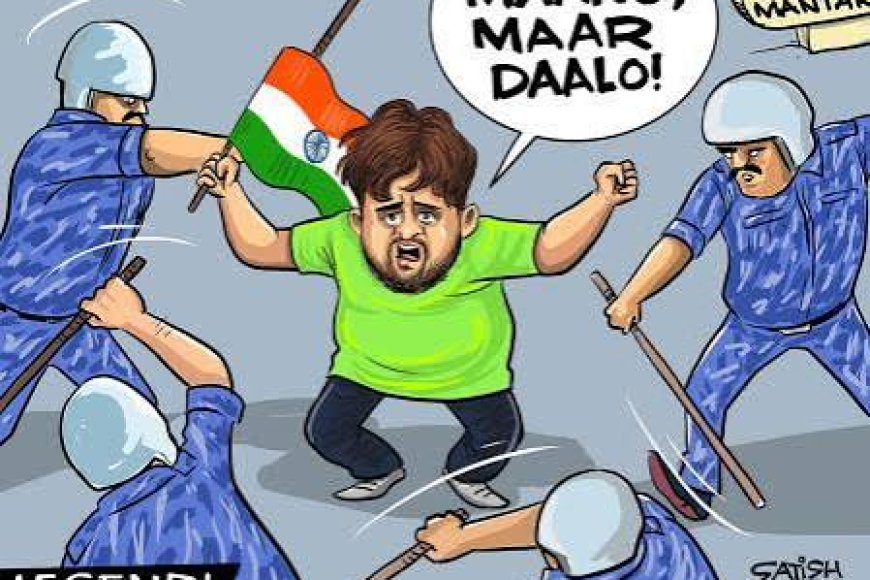
"Politicians can't ignore the Gen-Z anymore. Opposition parties should take lots of inspiration from these youngsters and they need to go fearless. The biggest lesson for the ruling party is you can't fool all the people all the time. At some point your tricks will stop working," Mr Acharya says in a must-read interview as he picks some of his most favourite cartoons from the Gen-Z protest.
'I always believed that Indian democracy is capable of coming up with a surprise or a miracle. But over the last one decade I had this apprehension that that ability of our democracy might have been snatched systematically. These youngsters made us optimistic again.'
As a cartoonist, how have the Gen Z protests influenced and shaped your work in the last few days?
As a cartoonist, I respond to news developments. So the Gen-Z protest was a big news development and I responded to that news through cartoons.
I can't say it influenced me, but it I have drawn cartoons on the protest as I saw it.
What story do these protests tell about the political imagination of this generation and their use of satire as a weapon of resistance?
It's novel and refreshing. I think most of the Gen-Z crowd gets their news in capsule forms, either through political memes on social media or through reels of journalists, comedians & influencers.
I don't expect them to spend hours going through political stories, which they may find boring.
But they're aware of the political developments, which is incredible. They love satire, reels and memes, so it's ok if they get their dose of political news through those channels.
Political cartoons have historically captured public dissent, which hasn't been easy in recent times. Yet students have fearlessly shown dissent through memes, reels, humour, posters on the streets.
Has their method of protest and communication opened up news ways of expressing satire? Will it potentially alter/change political commentary in the country?
I think that reflects this generation. Every generation discovers new ways to draw attention.
The most striking part of this Gen-Z movement is fearlessness.
When the richest businessmen, the most experienced editors/journalists, seasoned politicians, are so scared and they end up crawling in front of this regime, it was pleasantly surprising to see these youngsters speak their mind.
Political parties as well as news channels can't ignore them and their brand of dissent.
For an artist, how stimulating was it? How many cartoons did you make during this period? How were they received? Among the ones you made, which were your personal favourites?
Editorial cartooning is considered as a form of protest. During Anna Hazare movement I had drawn hundreds of cartoons on different phases of the movement.
I was really excited that I could contribute to the movement in my own way. Those cartoons always reach lots of people.
This time also I drew many cartoons as the movement unfolded. Whenever the movement was on a backfoot, I tried to draw more cartoons to encourage them.
I celebrated with them, through cartoons whenever the movement made progress.
My personal favourites are when a policeman fires tear gas, parents of the students say, 'No tear left' -- Policeman's child is scared and tells mom that 'there's papa under my bed'
As an observer and commentator, what have been some of the learnings for you from this protest? What does it reveal about India at this point in its history?
What does it tell us about our society, its anger and aspirations that the political class and institutions failed to recognise?
The biggest lesson is not for us, citizens, but for the politicians. Politicians can't ignore the Gen-Z anymore. Opposition parties should take lots of inspiration from these youngsters and they need to go fearless.
The biggest lesson for the ruling party is you can't fool all the people all the time. At some point your tricks will stop working.
Till now we were all under the impression that youngsters would get their political news from dinner table family talks. I had this fear that dinner table talks would result in brainwashing youngsters as parents talk toxic communal news.
But I'm so glad to realise that at least some section of youngsters depend on their own channels to know more about political developments.
What hope has this protest brought? And what accounts for the remarkable boldness and lack of deference towards political leaders?
This protest brought us HOPE.
I always believed that Indian democracy is capable of coming up with a surprise or a miracle.
But over the last one decade I had this apprehension that that ability of our democracy might have been snatched systematically. These youngsters made us optimistic again.
It would be really interesting to track how these protests will influence the coming state elections.