

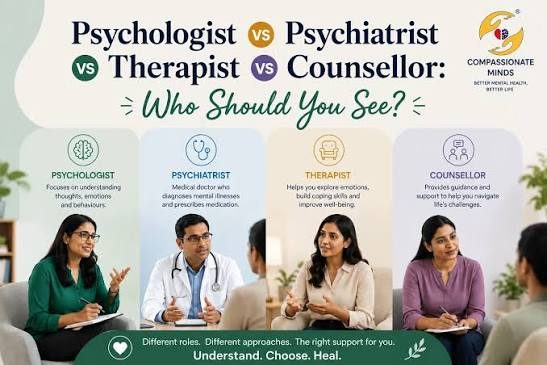
Hyderabad : For World Mental Health Day 2026, mental health professionals clarify the distinct roles of counsellors, therapists, and psychiatrists, offering guidelines on how to navigate symptoms and choose the right form of care.
Deciding to seek help for emotional distress or mental health challenges is a vital step toward long-term well-being. However, navigating the healthcare landscape often presents a confusing array of professional titles, treatments, and therapeutic approaches.
Understanding the distinct functions of counsellors, therapists, and psychiatrists helps individuals make informed decisions tailored to their specific needs.
Specialists share practical guidance on distinguishing these specialised roles, recognising when to seek help, and building an effective support system.
Mehezabin Dordi, Clinical Psychologist, Department of Rehabilitation & Sports Medicine, Sir H. N. Reliance Foundation Hospital, says, "Mental health support looks different for everyone.
The kind of professional you should approach depends on what you’re going through, how it is affecting your everyday life, and the support you feel you need."
Devyani Todi, Senior Psychologist at Amaha, notes, "A therapist, counsellor and psychiatrist all are important and have specific roles in mental health.
A counsellor is someone you reach out to if you are having day-to-day challenges like stress, burnout etc as they are trained to help you but not with serious mental health cases."
Dr Megha Agarwal, Consultant Psychiatrist, Kailash Deepak Hospital explains, "When people decide to seek help for their mental health, one of the first questions they ask is, “Should I see a therapist, a counsellor or a psychiatrist?” The terms can be confusing, but the main difference is their training and the support they provide.
A counsellor usually helps people work through concerns such as relationship difficulties, grief, stress or a major life change. Counselling gives you space to talk openly, understand your feelings and explore ways to cope.
A therapist is a broader term. Depending on their training, therapists may help with anxiety, depression, trauma, behaviour patterns or ongoing emotional difficulties through regular sessions."
Mehezabin adds, "A therapist can help you understand your thoughts, emotions and behavioural patterns, while working with you to develop healthier ways of coping.
Therapy can be helpful when dealing with anxiety, depression, trauma, relationship issues or difficulty managing emotions. It is important to choose someone qualified and experienced in addressing your specific concerns."
Devyani points out, "A therapist/ clinical psychologist has an MPhil and is trained in providing mental health services for more serious clinical cases.
A psychiatrist has an MBBS and is trained to provide psychiatric medications depending on the severity of the concern."
Medical Assessments, Knowing Where to Start, and Collaborative Support
Dr Megha highlights, "A psychiatrist, however, is a medical doctor who specialises in mental health. That medical training matters when symptoms are severe, persistent, affecting daily life or may be linked to a medical condition.
Psychiatrists can assess mental health conditions, prescribe medication when appropriate and monitor treatment.
For example, if someone is barely sleeping, struggling to function, experiencing severe depression or having thoughts of self harm, a psychiatric assessment may be important."
Mehezabin notes, "A counsellor can offer support when you’re dealing with particular challenges in life, such as grief, work-related stress, relationship difficulties or major life changes.
Counselling provides a safe space to talk through your feelings, gain clarity and explore ways to manage what you’re going through. The kind of support they can offer depends on their qualifications and training."
Devyani emphasises, "In serious mental health conditions, a therapist and a psychiatrist work as a team, and if you are unsure, if you visit a therapist or a psychiatrist, they will refer you or guide you."
Mehezabin explains, "A psychiatrist, on the other hand, is a medical doctor who specialises in mental health. They can assess and diagnose mental health conditions, prescribe medication when needed, and monitor how well treatment is working.
Consulting a psychiatrist can be particularly helpful when symptoms are severe, persist over time, or begin to interfere significantly with your daily life."
Dr Megha adds, "But you do not always have to choose one. Many people benefit from both medication and therapy. A psychiatrist may help manage symptoms, while a therapist helps the person understand patterns, build coping skills and work through difficult experiences. For milder concerns, counselling or therapy may be a good place to start.
If symptoms are intense, getting worse or disrupting work, relationships or sleep, seek a mental health assessment rather than waiting."
Mehezabin points out, "So, where should you start? If you’re struggling with stress, emotional difficulties or relationship concerns, a qualified therapist or counsellor may be a good starting point.
If you’re experiencing prolonged low moods, significant mood changes, symptoms such as hallucinations, or difficulties that are affecting your ability to function day to day, a psychiatric evaluation may be helpful. You don’t have to wait until things feel unmanageable before reaching out for support."
Devyani adds, "A counsellor is someone you reach out to if you are having day to day challenges like stress, burnout etc as they are trained to help you but not with serious mental health cases."
Mehezabin notes, "It is also important to remember that these professionals serve different roles and can work together. For some people, therapy alone may be helpful, while others may benefit from a combination of psychotherapy and psychiatric care."
Dr Megha concludes, "The important thing is not to diagnose yourself based on a label or feel that your problem is not serious enough to ask for help. If you are unsure where to begin, speak to a qualified mental health professional who can guide you towards the right support. Getting help can make recovery easier."
Mehezabin concludes, "Ultimately, seeking mental health support is not about finding the right label for what you’re experiencing. It is about understanding your needs and finding the kind of help that works for you. Reaching out early is a positive step towards taking care of yourself, not a sign of weakness."