
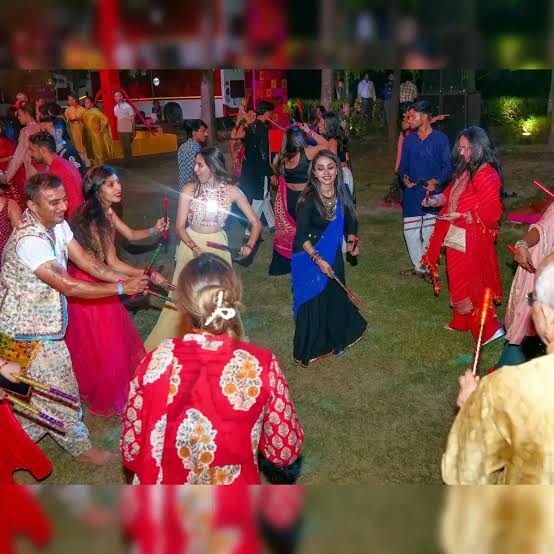
Mumbai : The Vishva Hindu Parishad (VHP) has announced stringent new guidelines for the upcoming Navratri festival in Maharashtra, effectively barring Muslims from 'garba' and 'dandiya' events and mandating identity checks like Aadhaar and 'tilak' for participants.
The Vishva Hindu Parishad has decided to prohibit Muslims from participating in 'garba' and 'dandiya' events during the upcoming Navratri festival in Maharashtra.
Organisers are instructed to implement identity verification measures, including checking Aadhaar cards and applying 'tilak' to confirm Hindu identity of participants.
VHP spokesperson Shriraj Nair stated that Navratri is a religious festival for worshipping the Goddess, and Muslims, who are against idol worship, should not participate.
Nair described these restrictions as precautionary measures to protect the cultural character of Hindu festivals, not as being against any specific community.
The VHP's stance contrasts with recent remarks by RSS chief Mohan Bhagwat on universal oneness and dignity for all people.
The Vishva Hindu Parishad has decided to bar Muslims from taking part in 'garba' and 'dandiya' events during next month's Navratri festival across Maharashtra, and also set "guidelines" for the organisers to verify the Hindu identity of participants.
These measures include checking the Aadhaar cards of attendees and applying 'tilak' on their foreheads. The Navratri festival will begin on October 11.
VHP Explains Garba Participation Rules : VHP spokesperson and joint secretary Shriraj Nair said the organisation took the decision to prevent participation of Muslim community members in garba and dandiya events. "We have taken a decision of not allowing participation of Muslims in garba-dandiya dance during the Navratri festival," Nair said.
"Navratri is not just about songs and dance. The festival is about worshipping the Goddess. Why should Muslims, who are against idol worship, participate in the festival?" he said.
The VHP also issued guidelines for the organisers, including checking the Aadhaar cards of attendees and applying tilak on their foreheads as measures to verify their Hindu identity.
Nair said the restrictions did not mean that the VHP was against any particular community, and described them as precautionary measures aimed at protecting what the organisation considers the cultural character of Hindu festivals.
"The VHP, which is unwilling to compromise on its core agenda of religious conversion and anti-cow slaughter, believes festivals are an integral part of the cultural legacy of the Hindus. And it cannot allow its dilution. However, it admits the restrictions are precautionary measures and not directed against Muslims or any other communities," he said.
VHP's Position Amidst Broader Dialogue
Nair's remarks came days after RSS chief Mohan Bhagwat, while addressing a gathering at Madison Square in New York, stressed the need for universal oneness and dignity for all people.
"If any Hindu thinks there should be no Muslims in India, he will not remain Hindu. If you want to call yourself a Hindu, you have to believe that all paths are leading to the same goal. Every human has dignity. There is no difference between human beings," Bhagwat had said.
When he was asked to respond to Bhagwat's remarks, Nair said the VHP would not comment on the RSS chief's statement.
"We are not against anybody. We also believe in social harmony and peace," he said.
Conditions For Muslim Engagement In Navratri : Nair, however, questioned why the VHP should relax its guidelines for people who, according to him, do not subscribe to the religious beliefs and form of worship associated with the festival.
"The point is, why should we relax our guidelines for Muslims who don't subscribe to our religious beliefs and style of worship?" he said.
"If Muslims are keen to participate in the Navratri festivities, they should come with their family members, wives and sisters. They should organise the Navratri festivals in the mosques or places of their residences," Nair said.