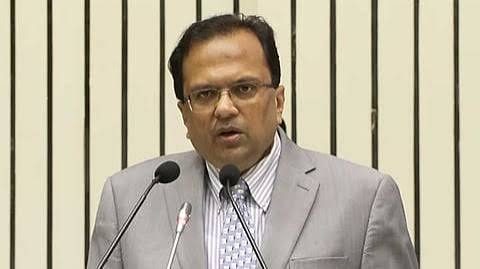

New Delhi : Minister of State for Home Nityananda Rai said the Congress should have given Vande Mataram its due respect during its 76 years of rule, but instead it resorted to appeasement politics.
Vande Mataram, the national song that has stirred passions and political controversies for more than a century, received legal protection on Thursday with Parliament passing a bill making any insult to it a punishable offence, rekindling the long-running debate over its place in India's history and identity.
The government asserted that the Prevention of Insults to National Honour (Amendment) Bill, 2026, grants Vande Mataram a status on par with the national anthem Jana Gana Mana under the law by extending to the national song the existing penal provisions against intentionally preventing its singing or causing disturbance during its rendition. Such offences are punishable with imprisonment up to three years, a fine or both.
A second and every subsequent conviction is punishable with imprisonment of a minimum of one year.
The bill was passed amid noisy scenes in the Lok Sabha.
Responding to a brief debate in the Lower House in which only two members participated, Minister of State for Home Nityananda Rai said the Congress should have given Vande Mataram its due respect during its 76 years of rule, but instead it resorted to appeasement politics.
"For Ek Bharat, Shreshtra Bharat, we need the complete (all six stanzas) Vande Mataram song," Rai said, as he concluded his brief reply to the bill with a chant of Vande Mataram.
The bill was passed by voice vote after the two members spoke.
The amendments moved by the Opposition were rejected by the House. A Raja of DMK later tore some documents and threw them towards the Well. Earlier, DMK member K Kanimozhi opposed the bill, saying it is a "Hindutva agenda" brought masquerading as nationalism.
"It is against federalism. You cannot impose nationalism by bringing a law; the song goes against the secularism of the country. The founding fathers had the wisdom to stop only with two stanzas, but today you are trying to polarise the country by making it compulsory and making it a criminal offence if we do not sing all the six stanzas," she said.
Sambit Patra of the BJP said the Congress in its 76 years of rule did not give Vande Mataram the respect it deserved as a national song.
The national song has continued to stir heated debates every few years over its "secular" or "anti-Islamic" nature and the role it played in India's freedom struggle.
In November last year, Prime Minister Narendra Modi said that important stanzas of the national song were dropped in 1937, which sowed the seeds of partition and asserted that such a "divisive mindset" is still a challenge for the country.
"Unfortunately, in 1937, important stanzas of Vande Mataram... its soul was removed. The division of Vande Mataram also sowed the seeds of partition," he said.
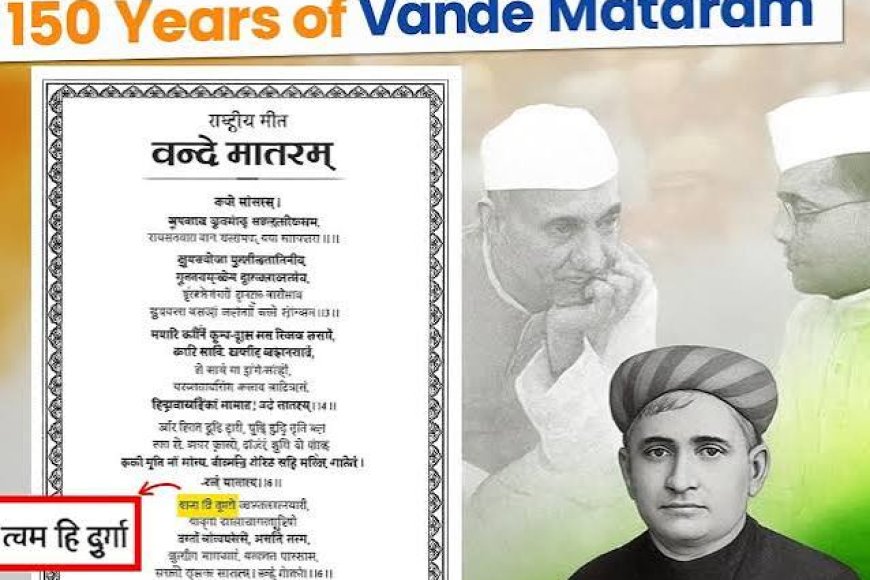
Since its origin at the hands of Bengali novelist-poet Bankim Chandra Chatterjee in 1875 as an ode to the motherland, a personification of Goddess Kali, the poem has time and again found itself at the eye of many a political storm.
First published in 1882 in the literary journal, "Bangadarshan", as part of Chatterjee's novel, "Anandamath", Vande Mataram had become a rebellious call against the British by the turn of the century, popularised by the nationalistic leaders of the Indian National Congress.
According to a 1953 publication by the Ministry of Information and Broadcasting, it was first sung at a political occasion at the 1896 session of the Indian National Congress, set to music by Rabindranath Tagore.
The song gradually adapted the essence of an anthem as the anti-partition movement in Bengal grew in the early 1900s. It was during these days that the Muslim leaders showed early protest to the popular use of the poem.
The original Vande Mataram, a poem in six stanzas, has strong religious lyrics in the later parts, evoking the imagery of and paying obeisance to the goddess Durga and Lakshmi. In his presidential address to the second session of the All India Muslim League held at Amritsar on December 30, 1908, Syed Ali Imam said that his "heart is filled with despair and disappointment" when "the most advanced province of India put forward the sectarian cry of 'Bande Mataram' as the national cry".
"...and the suspicion that, under the cloak of nationalism, Hindu nationalism is preached in India becomes a conviction," he said.
The poem, especially the first two words -- Vande Mataram -- gradually became the slogan of the nationalist movement.
According to an article in Economic and Political Weekly by senior Supreme Court lawyer A G Noorani, written in the wake of objections raised against singing of the national song in a municipal school in Bombay in 1973, the Muslim League in a resolution adopted by its 25th session in Lucknow in 1937 dubbed Vande Mataram as "not merely positively anti-Islamic and idolatrous in its inspiration and ideas, but definitely subversive of the growth of genuine nationalism in India".
Days later, the Congress Working Committee, which met at Calcutta on October 26, 1937, under the presidentship of Jawaharlal Nehru, adopted a resolution on the subject and noted that "wherever Bande Mataram is sung at national gatherings, only the first two stanzas should be sung, with perfect freedom to the organisers to sing any other song of an unobjectionable character, in addition to, or in the place of, the Bande Mataram song".
Mahatma Gandhi, who associated "the purest national spirit with it", admitted that 'Vande Mataram' had "gripped and enthralled" him but it never occurred to him that it was "a Hindu song or meant only for Hindus". Even after Independence, Gandhi counselled against the imposition of Vande Mataram.
"No doubt, every act... must be purely voluntary on the part of either partner", he said at Alipore on August 23, 1947, according to Noorani.
However, over the next eight decades, the contentious issue of singing the national song has cropped up in its support as well as in its opposition.
One of the biggest controversies occurred in 2009, when Jamiat Ulama-i-Hind in Deoband, Uttar Pradesh, issued a fatwa asking Muslims not to sing the national song.
Strongly opposing the Islamic organisation, over 100 Muslim scholars, social activists, actors, and writers released a statement and said that the debate on Vande Mataram was settled in the 1930s with the consent of the then leadership of the Jamiat.
"We strongly condemn the Jamiat move to unnecessarily provoke a controversy around Vande Mataram at this juncture," the statement said.
The issue of singing the national song in a BMC school in 1973 came up again in 2017 when BJP corporator Sandip Patel moved a proposal to make the singing of Vande Mataram mandatory in civic-run schools.
In 2018, then-BJP president Amit Shah held the Congress responsible for the country's partition, alleging that the party had surrendered before the politics of appeasement.