
Hyderabad: On July 1, Anas Mirza and his friends asked an employee at Wonderla, the amusement park on Hyderabad’s outskirts, for a photograph. He refused.
He only posed with children, he told them. As the young men turned to leave, he said, “Maardena musalmano ko (Kill all Muslims).”
They had recorded it. Their complaint to the park’s management went nowhere. Mirza posted the video on Instagram and only after it spread did Wonderla fire the man and express regret.
“I have never expected I would experience this in my city,” Mirza told Siasat.com.
Child dressed as a clown with sunglasses and a blue hat, standing outdoors on a brick pavement.
The worker at Wonderla in Hyderabad was caught on video saying “Maardena musalmano ko.”
That sense of a familiar place turning strange runs through Siasat.com‘s hate crime tracker for Telangana.
Between July and September 2026, it logged 20 such incidents in the state, nearly three times the seven from April to June, though fewer than the 27 between January and March.
Few of these were the communal flare-ups that make national headlines. Most were smaller and more ordinary: a flat refused, a slur at a theme park, a line in a child’s school diary turned into a “conspiracy,” roads washed with turmeric water after Dalits had walked on them. The targets were largely Muslims, Christians and Dalits.
The quarter’s most charged episode began with that diary. At Success The School, in Hyderabad’s Saidabad, a teacher wrote “Read Kalima” in a Class 2 student’s diary on July 11, then struck it out, apparently after realising it did not apply to a non-Muslim child.
On July 15, “Read Surah Fatiha” appeared in the same diary under the subject Deeniyath. The boy is Hindu.
Student assigned Kalma recitation as homework at Success The School in Hyderabad.
The management said nearly all its students are Muslim and study Deeniyath, or Islamic studies, which is not meant for non-Muslim students. It called the entry an inadvertent mistake but sacked the teacher anyway.
Police registered a first information report (FIR) under the Juvenile Justice Act, and the National Human Rights Commission (NHRC) issued a notice to the state government.
Days of tension in the Old City followed. The boy’s father, G Rajashekhar, said the family withdrew its complaint of its own accord. The Vishva Hindu Parishad (VHP) still wanted the state government to step in, calling the episode a possible “conspiracy.”
A VHP leader alleged the teacher had tried to convert the child. His was one of many such claims in the Hindutva ecosystem, and this was not the first time an incident had been spun into talk of “conspiracies,” “forced conversions” and a “religious agenda.”
The kalma row and Mirza’s video were two of nine incidents logged in July.
In Warangal, a government employee, Nadeem, echoed Mirza. In a viral Instagram video, he said a woman living in an apartment complex refused him a flat and turned rude once he said he was Muslim. It was the first time, he said, that he had faced Islamophobia in Telangana.
In Gachibowli, a Cyberabad Police officer was filmed telling a Muslim woman and her teenage son, “This is not Pakistan and Afghanistan to park as you like.”
In Attapur on July 26, a Muslim man alleged that a woman called him a “terrorist” during an argument over a parking mishap. A video of the exchange was later restricted on social media.
Security officer in uniform holding a tablet next to a handwritten note.
On July 8, 24-year-old Mohammed Mahboob was beaten on Jalpally Road, under Pahadishareef Police limits. He says a man called him “Turkalu,” a slur for Muslims, and hit him with a helmet before others joined in.
He suffered injuries to his head, mouth, teeth and eyes, and briefly lost consciousness. Police deny any communal angle, calling it a personal altercation and saying Mahboob was intoxicated.
In Nagarkurnool, Bharatiya Janata Party (BJP) and Akhil Bharatiya Vidyarthi Parishad (ABVP) functionaries accused a school of trying to convert students.
BJP mandal president Deo told a teacher he knew of “a big Christian mafia in India which is trying to convert people,” and the group filed a police complaint alleging forced conversion.
August saw less physical violence but more cultural polarisation. Actor Faria Abdullah was abused online and called a “kafir” for taking part in Bonalu, a Hindu festival.
In a tearful Instagram video on August 15, she said her father, Sanjay, had converted to Islam “because he liked the religion,” and that being raised by someone who chose the faith out of love had taught her to see the good in it and to meet hatred without hatred. To those calling her a kafir, she said she wished them well.
The Ganesh Chaturti festival brought the usual politicking and flashpoints. In Madannapet on September 20, police detained three residents of a housing society near Chanchalguda after a packet of bones and food waste was allegedly thrown near an annadanam, or free meal, at a Ganesh event. BJP workers and Hindu groups protested.
Accounts of what was thrown differ, with the police describing non-vegetarian material “like beef,” the FIR mentioning meat waste and others saying chicken bones.
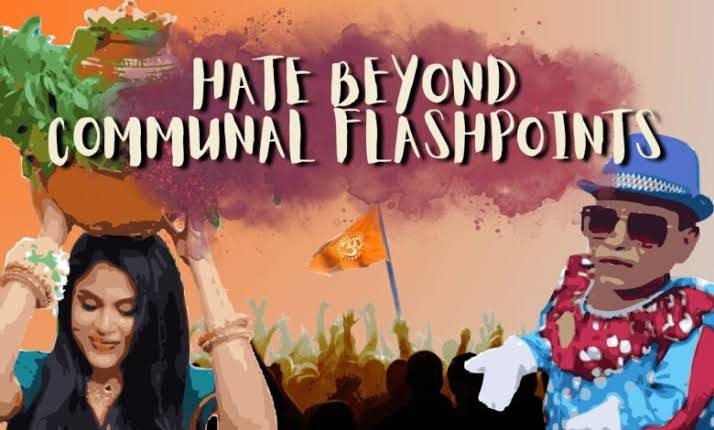
Sanjeev, general secretary of the Human Rights Forum (HRF) in Hyderabad, traces many of the state’s communal flashpoints to “H-Pop,” or Hindutva pop, a genre of hyper-political music increasingly played at festivals and public events to provoke.
HRF’s fact-finding has found H-Pop at the root of several communal incidents in recent years, he told Siasat.com. In one, the songs were played near a mosque during Friday prayers when Holi fell during Ramzan, in an old basti where Hindus and Muslims had lived peacefully for years.
“The situation initially subsided, but then VHP and BJP stepped in,” he said. Leaders such as Bandi Sanjay, Sanjeev alleged, broke police protocol and entered barricaded areas, stoking tension.
523 Hindutva pop songs of hate streamed across YouTube, Spotify
Campuses are not immune either.
At a 2023 freshers’ event at the University of Hyderabad (UoH), H-Pop tracks played after the faculty left caused a ruckus. “Once you start paying attention to the music during festivals, you’ll notice that most of the time, the music is H-Pop,” Sanjeev said.
On September 13, Burugu Karthik, 26, was attacked with a knife and a wooden stick near a Ganesh mandapam in Secunderabad’s Tukaramgate and died at Gandhi Hospital.
Police say five members of one family had nursed a grudge since 2023, when Karthik helped the main accused’s daughter marry a man from another caste against their wishes. All five have been arrested and the case has been registered under the SC/ST Act.
Five days earlier, on September 8, Congress workers and Dalit groups marched towards K Chandrasekhar Rao’s (KCR) farmhouse at Erravalli in Siddipet, protesting remarks by Bharat Rashtra Samithi (BRS) MLCs against Assembly Speaker Gaddam Prasad Kumar, a Dalit.
BRS workers then sprinkled turmeric water to “purify” the roads they had walked on. The Congress raised the matter the next day and police have since arrested seven people in one of three cases under the SC/ST Act.
Group of people protesting and pouring water on roads during a Dalit protest in India. BRS allegedly purifying roads after Dalit Congress workers protest
The Congress had caste trouble of its own. The Telangana president of its student wing National Students’ Union of India (NSUI) Yadavalli Venkataswamy, the first Dalit to head the body in undivided Andhra Pradesh and Telangana, publicly alleged caste bias within the party over his caste and removing him before his term ended.
Sanjeev says that despite the rise in hate crimes, Telangana’s communal fabric is holding. He cited the “Bun Kova” incident earlier this year, when right-wing groups targeted a Muslim vendor near a temple in the name of “food jihad” and locals rejected the harassment.
Asked about incidents against Hindus, he said, “The way we see it, from Muslims it is usually a response and not organised. Rashtriya Swayamsevak Sangh (RSS) and BJP, on the other hand, are much more organised.”
Telangana, he insists, is not fertile ground. “Though BJP tries a lot,” he said, “it cannot make an impact.”