

Modi-Takaichi Summit Opens New India-Japan Chapter
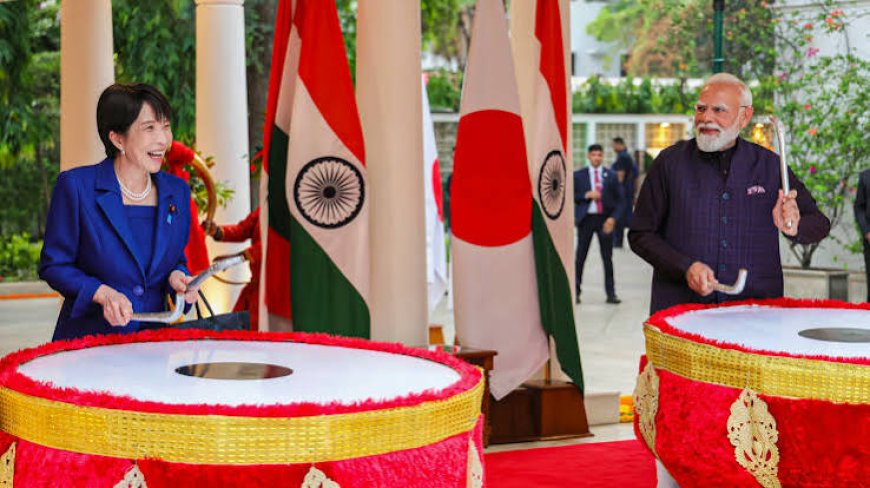
New Delhi / Tokyo : Notwithstanding the economic complementarities and the host of agreements for deepening economic relation on a host of areas, both sides share common viewpoints on the foreign policy domain and seek common grounds to serve as a counterweight to China, notes Dr Rajaram Panda.
Prime Minister Takaichi Sanae's first India visit culminated in agreements covering strategic, economic, defence and technology cooperation.
India and Japan reaffirmed their target of attracting 10 trillion yen in Japanese investment over the next decade.
Both countries intensified cooperation in semiconductors, artificial intelligence, critical minerals and resilient supply chains.
Modi and Takaichi jointly inaugurated Maruti Suzuki's Kharkhoda manufacturing facility, boosting India's industrial ambitions.
India and Japan aligned strategically on Indo-Pacific security, economic resilience and reducing dependence on China.
Japanese Prime Minister Takaichi Sanae paid her first official trip to India from July 1 to 3 , 2026 since assuming office as Japan's Prime Minister in October 2025 on the invitation of Prime Minister Narendra Modi and held the 16th Annual Summit meeting with her Indian counterpart followed by the signing of an agreement to boost strategic partnership.
What struck an emotional cord was when Modi called Takaichi his 'young, beautiful sister, hailing Japan's role in India's growth,
Takaichi complemented with her observation of Modi as her elder brother after Abe Shinzo's tragic assassination in 2022 with whom she had a special bonding and Modi had established a good rapport.
The bilateral talks were followed by the exchange of MoUs and press statements.
Taking note of the steadily expanding economic partnership, with around 120 new business agreements signed over the past year, PM Modi set an ambitious target of $10 billion investment from Japan into India.
Addressing a joint press conference with Takaichi after bilateral talks, Modi said the newly signed agreement between the two countries' Financial Services Agencies would further ease the flow of capital and investments.
He highlighted an ambitious roadmap for the next decade, stating that India aims to attract 10 trillion yen in Japanese investment and double the number of Japanese companies operating in India.
Indeed, the improvements in the ease of doing business have created fresh opportunities for Japanese firms to expand their presence and participate in India's growth story.
Indeed, Takaichi's maiden visit to India for the 16th India-Japan Annual Summit opens up 'a new chapter', as described by Modi, in the two countries' Special Strategic and Global Partnership.
At the press conference, Modi noted Takaichi's roots in Nara prefecture, region closely linked to the shared Buddhist heritage of India and Japan.
The friendship between the two nations has a long history rooted in spiritual affinity and strong cultural and civilizational ties.
There is synergy between India's Act East Policy, Indo-Pacific vision based on the principle of SAGAR, and Indo-Pacific Ocean Initiative (IPOI) on one hand, and Japan's Free and Open Indo-Pacific Vision on the other.
Indeed, mutual trust is the greatest strategic asset between the two countries amid global uncertainty. As regards ties with India, Japan has played a pivotal role in India's development over the decades -- from automobiles to electronics.
Taikaichi's visit would further deepen bilateral cooperation and strengthen the longstanding friendship between the two nations.
A MoU was signed seeking to deepen cooperation across key sectors, including trade, investment, technology and strategic collaboration, reinforcing their Special Strategic and Global Partnership.
Both leaders also reviewed the full, spectrum of the relationship focusing on trade, investment, defence, economic security, high-technology cooperation, connectivity and regional developments in the Indo-Pacific.
Inauguration of Maruti Suzuki's Kharkhoda plan : One major highlight of Takaichi's visit was both Modi and Takaichi jointly inaugurated Maruti Suzuki India's manufacturing facility in Haryana's Kharkhoda, marking a major milestone in industrial cooperation.
This marked one of the biggest investments in India's automobile sector in recent years. Built with a planned investment of Rs 35,000 crore (Rs 350 billion), the company's fourth manufacturing plant in India is expected to add an annual production capacity of 10 lakh (1 million) vehicles and generate more than 21,000 direct jobs.
The state-of-the-art facility will operate entirely on renewable electricity and feature AI-enabled manufacturing systems, reinforcing its commitment to sustainable and technology-driven automobile production.
This new manufacturing facility is a significant investment bolstering India's automotive sector.
This advanced plant, built with industry 5.0 technologies and a focus on sustainability, marks a key step in the 'Make in India, Make for the World' initiative.
The inauguration was held as part of the India-Japan Economic Forum, where over 150 Japanese companies participated as the two countries looked to deepen cooperation across manufacturing, semiconductors, artificial intelligence, clean energy and mobility.
The Kharkhoda manufacturing facility is Maruti Suzuki's fourth manufacturing facility in India after Gurugram, Manesar and Gujarat. The foundation stone for the facility was laid virtually by Modi in August 2022.
Suzuki Motor Corporation's Indian subsidiary commenced commercial production at the plant from February 25, 2025.
The visit that focused on expanding India-Japan cooperation through both government and private sector participation, including the India-Japan Economic Forum, also saw participation from over 150 members of Japan's business community.
Takaichi committed Japan's resolve to strengthen the partnership across strategic, economic and innovation-driven areas.
Both leaders exchanged agreements on economic and energy sectors, along with pacts in cooperation in other segments like AI, semiconductors, and more.
The joint statement of July 2 confirmed cooperation in security, economic security and energy, and economic growth.
As Japan promotes its diplomatic vision of a Free and Open Indo-Pacific, it is seeking to deepen cooperation with India, one of its most important like-minded partners, while countering China's growing influence.
Modi emphasised that a free and rules-based Indo-Pacific is a shared priority for the two countries.
With an eye on China, which is increasingly wielding economic coercion, Japan is seeking closer cooperation with India to strengthen its autonomy in critical sectors such as semiconductors and critical minerals.
In the joint statements, the two countries expressed "serious concerns" over economic coercion, including export controls, as well as developments in the East China Sea and South China Sea.
The two leaders also emphasised the importance of building supply chains among like-minded nations.
Both leaders also agreed to promote talent development, technological cooperation and Japanese companies' participation in India's semiconductor industry.
They also pledged to enhance technical cooperation and information sharing in the exploration of critical minerals.
Under 'Power Asia', a Japan-led framework that provides financial support to secure crude oil supplies, the two countries will establish a bilateral dialogue aimed at strengthening India's petroleum reserve system.
On security, they agreed to expand joint exercises in areas such as the Indian Ocean and to cooperate on naval vessel maintenance.
They will also promote collaboration on the joint development of defense equipment under India's manufacturing promotion initiatives.
The leaders further agreed to hold a Japan-India 'two-plus-two' meeting of foreign and defense ministers within the year.
As mentioned, representatives from about 150 Japanese companies were in Takaichi's entourage.
Japanese and Indian companies, as well as government-related organisations, concluded a total of 129 MoUs, including planned investments totalling about 2 trillion yen ($12.4 billion) in fields such as semiconductors and artificial intelligence, in addition to the automotive and manufacturing sectors.
Currently, 1,434 Japanese companies were conducting business in India as of October 2024, up by 35 from the previous year. The number has remained largely flat in recent years.
Despite the synergy and complementarities, the differences in the business culture, in doing business, inhibits to some extent the involvement of participation of Japanese companies with Indian companies.
There are also other obstacles. Japanese are a bit uncomfortable with India's complex tax system and regulations, labour-related issues such as strikes and wage negotiations, and differences in business practices.
To address these challenges, Japan's foreign ministry established the Japan-India Economic Affairs Division in April to support Japanese companies seeking to enter the Indian market.
One reason India is attracting strong interest from Japanese businesses is its potential in cutting-edge fields, including emerging technologies.
In 2025, the governments of India and Japan agreed on a 10 trillion yen target for private investment in India over the next decade.
During the latest summit, the two leaders reaffirmed cooperation in creating an environment conducive to innovation.
India also possesses a large pool of science and engineering talent. In a separate joint statement on AI, the two governments confirmed a goal of bringing 500 Indian AI specialists to Japan by 2030 to promote joint research.
India reportedly churns out approximately 1.5 million engineering graduates every year, but many degree holders struggle to find stable employment.
For young people seeking opportunities to utilize their technical education, Japan, where labour shortages persist, is becoming an option.
The most striking part of the deal was that both Modi and Takaichi resolved to reduce their dependence on China and build more resilient supply chains in the fields of semiconductors, critical minerals, quantum technologies.
Modi was clear that to attract 10 trillion yen in investment from Japan to India and to double the number of Japanese companies operating in India over the next decade is a defined strategy for India.
In this endeavour Modi stated that continuing economic reforms that had improved the ease of doing business, thereby creating fresh opportunities for Japanese companies, are government's goal to facilitate the flow of capital and investment.
The two leaders oversaw the exchange of agreements covering artificial intelligence, metals and energy security, financial cooperation and next-generation mobility.
While releasing a joint statement on AI and in a major defence outcome, both countries signed their first co-development agreement for the Naval Radio Antenna 'Unicorn', which Modi described as a project that would 'open a new chapter in our defence technology partnership'.
Economic security remained one of the central themes of the summit, with New Delhi and Tokyo reaffirming their commitment to building resilient supply chains amid growing geopolitical uncertainty.
The two countries identified semiconductors, critical minerals, pharmaceuticals, clean energy, and information and communication technology as priority sectors for deeper strategic cooperation.
Artificial intelligence also figured prominently in the discussions, with the newly signed agreement expected to provide fresh momentum to collaboration between India's digital ecosystem and Japan's advanced manufacturing capabilities.
New Delhi and Tokyo have steadily built the institutional framework for this cooperation over the past few years.
They signed a memorandum on semiconductor supply chains in 2023, followed by an agreement on mineral resources in 2025, while the first joint working group under the critical minerals partnership met earlier in 2026.
The second India-Japan Economic Security Dialogue was held in May, alongside a dedicated private-sector dialogue between Japan's Keidanren and the Confederation of Indian Industry.
Energy security featured prominently during the summit. Besides signing a pact on metals and energy security, the two countries launched the India-Japan Bio-gas Initiative to establish 1,000 bio-gas and organic fertiliser plants across India, which will give new strength to sustainability, prosperity, and rural livelihoods in India's villages.
Both sides are also considering cooperation on liquefied natural gas stockpiling and information sharing as part of broader efforts to reinforce energy security.
Both sides expressed concerns over economic coercion and non-market practices affecting global supply chains, including restrictions on rare earth exports.
The 150+ Japanese companies that participated in the India-Japan Economic Forum were part of the 120 cooperation agreements that were announced.
The areas of cooperation valued at roughly $12.5 billion from semiconductors, clean energy, AI and manufacturing.
Among the projects announced included Fujifilm's semiconductor materials facility, Suzuki's biogas initiative and collaborations between Japanese and Indian AI start-ups.
These investment proposals were build on the commitment announced at 2025 annual summit when both sides set a target of attracting 10 trillion Yen in private Japanese investment into India over the next decade.
Despite business differences, India remains as one of Japan's most important investment destinations.
Japan is India's fifth-largest investor, with cumulative investments of more than $48 billion between April 2000 and March 2026.
Though around 1,500 Japanese companies currently operate in India as per JETRO's report, more than one out of five Japanese affiliated firms in India intend to expand their operations over the next one to two years.
Bilateral trade between the two countries crossed $27 billion in 2025-2026, reflecting steadily expanding commercial ties.
Notwithstanding the economic complementarities and the host of agreements for deepening economic relation on a host of areas, both sides share common viewpoints on the foreign policy domain and seek common grounds to serve as a counterweight to China.
While India pursues a multi-aligned diplomatic approach aimed at securing strategic autonomy, Tokyo sees New Delhi as a partner indispensable to promoting its Free and Open Indo-Pacific diplomatic vision.
So, expanding cooperation in the maritime security domain is a priority for both countries.
Dr Rajaram Panda is former Senior Fellow at MP-IDSA and PMML. He is also former ICCR Chair Professor at Reitaku University, Japan.