

Will Indians Get To Watch FIFA World Cup 2026?
Maxico : With less than a month to go, football fans have all fingers -- and toes -- crossed.
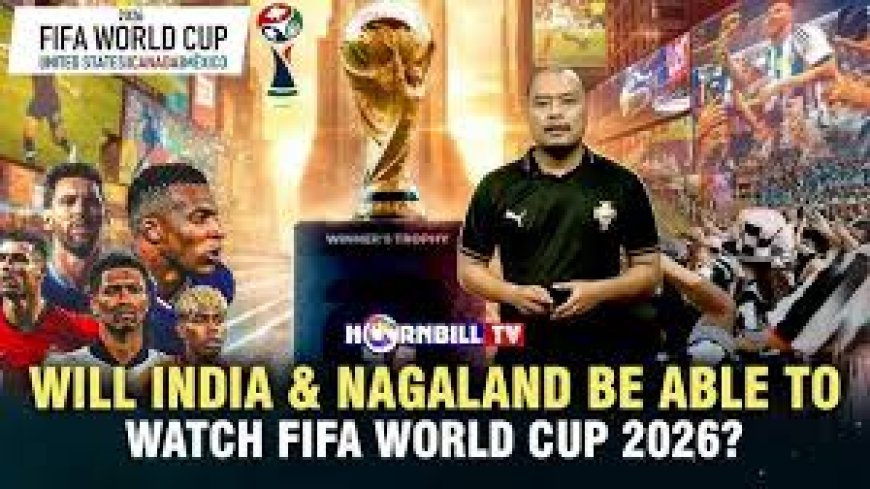
The FIFA World Cup trophy. Uncertainty over FIFA World Cup broadcasting in India has revived nostalgia around Doordarshan's historic football coverage era.
Doordarshan introduced generations of Indian viewers to global football stars including Diego Maradona during the 1986 tournament.
Private broadcasters transformed football coverage in India after 2002 with full tournament telecasts and studio-based programming.
Escalating FIFA broadcasting rights and IPL's commercial dominance weakened the business case for football broadcasting in India.
Speculation is growing that Doordarshan could again step in if private broadcasters avoid FIFA's expensive 2026 rights demands. Nostalgia for Doordarshan is not a sentiment that normally afflicts one.
But dismaying news that Indian football fans may not get to watch the upcoming FIFA World Cup raised memories of a less commercial, almost innocent age when the State-owned broadcaster quite unexpectedly broadcast the 12th edition of the World Cup.
Memories of that 1982 tournament, when only the semi-finals and finals were broadcast, are hazy. At the time, DD charged its citizens a nominal licence fee, which was discontinued a couple of years later when advertising revenue surged.
But fans of a certain generation will forever be grateful to DD for bringing to our TV screens the wizardry of Diego Maradona -- with and without the Hand of God -- in the 1986 World Cup in Mexico.
That year was the coming of age of the Indian football fan. For a decade thereafter -- including the late-night matches of the 15th edition hosted exclusively in the United States -- DD extended its coverage to key matches plus quarters, semis and finals.
Anchored by the hardy duo of Narottam Puri and Novy Kapadia, stars shining on distant foreign fields became household names in the addas of Calcutta, as it was known then.
The entry of private satellite broadcasters lent an added kick to this new-found mania for international football.
These channels began to selectively beam the popular European and South American tournaments.
Inevitably, then, from 2002, it was a private channel that brought us the World Cup played in Japan and South Korea.
This was the first time the tournament was broadcast in its entirety -- from the first rounds to the final and even the third-place play-off -- plus opening and closing ceremonies, and American singer Anastacia's rendition of Boom, the official anthem, ahead of each match.
The broadcaster (Ten Sports, a fledgling channel owned by the same United Arab Emirates businessman who brought cricket to Sharjah) acquired the rights from a bankrupt German media company for an undisclosed amount.
Though Ten Sports relied on a professional British network for the match coverage, former English players appeared in locally produced pre-, mid- and post-match programmes.
Their expert comments were delivered in accents so thick as to render most of their wisdom unintelligible.
IPL dents football viewership
ESPN-Star Sports, the rising power in sports broadcasting, brought us the next two editions of the tournaments in 2006 (Germany) and 2010 (South Africa).
To the standard fare of former players dispensing expert views came the addition of a woman anchor, with elaborate gowns and coiffures wholly out of place in a football programme.
At the same time, FIFA, the governing body for which the World Cup remains its biggest revenue earner, raised the asking price from $8 million to $9 million in the first to $40 million for the next.
But four years later, Sony Six paid a bargain price of $90 million for the 2014 (Brazil) and 2018 (Russia) editions plus the Euro 2016 tournament, suggesting that the Indian subcontinental market had cooled.
What changed was the explosive success of the Indian Premier League, which started in 2008.
By 2014, IPL had gained so much traction that it had cannibalised advertising revenues for many other sports -- including one-day international cricket and Tests.
By the 2022 edition in Qatar, Reliance's Viacom18 bagged the rights with a $60 million deal that included television and digital rights.
Through its merger with Disney's Star India, Reliance-Disney is part of a duopoly in sports broadcasting in India with Sony Ten.
Its reluctance to stump up FIFA's asking price of $100 million for the 2026 and 2030 editions reflects the truth that there really aren't that many football fans in India after all. Even kabaddi attracts higher viewership.
With matches played across the US, Mexico and Canada, starting at 12.30 am through to 11 am the next day, the broadcaster expects subdued viewership and, therefore, advertiser interest.
More so when the tournament coincides with the Women's T20 World Cup tournament and Wimbledon, both to be broadcast on the same network.
Small wonder, the Star-Jio's offer is $20 million for only the 2026 edition, which has left the notoriously profit-motivated FIFA aghast.
Now the Internet bristles with rumours that DD might step into the breach, just as it did with the Women's World Cup football in 2023.
Whether DD will agree to pay upwards of Rs 900 crore (about $100 million) to entertain a small segment of Indians is an open question.
Either way, with less than a month to go, football fans have all fingers -- and toes -- crossed.